


Build Cool, Build Smart: How Natural Hardwood Is Redefining Climate-Responsive Villa Design in Bali.
The Problem Nobody Talks About in Bali's Luxury Villa Market Bali has long been a dream destination for world-class villa living. The views are extraordinary, the culture is unmatched, and the landscape offers something no other island can replicate. But behind the infinity pools and the open-air pavilions lies a challenge that every developer, architect, and villa owner on the island quietly wrestles with: the climate. Intense tropical heat. Near-constant humidity. Monsoon rains that push moisture into every surface. Coastal salt air that attacks materials from the outside in. UV radiation that bleaches, warps, and degrades lesser materials within a single season. In 2026, Bali's most ambitious villa projects are solving this challenge not with air conditioning systems or imported engineered materials, but with something far older and far more intelligent: climate-responsive architecture built around natural tropical hardwood. This is the new frontier of conscious luxury in the tropics. And reclaimed wood is at the center of it.
4/27/20267 min read
What Is Climate-Responsive Design, and Why Does It Matter Right Now?
Climate-responsive design is an architectural philosophy that uses the building itself to manage heat, airflow, moisture, and light, rather than relying on mechanical systems to compensate for poor material and spatial choices.
In 2026, this principle evolves further through biophilic design: open courtyards, transitional shaded spaces, living walls, natural pools and filtration ponds, and a visual connection to rice fields, jungle, or ocean. The goal is not just aesthetic openness, but psychological and ecological balance. Villas that disconnect from nature lose their very essence.
This shift is happening for both ecological and financial reasons. Eco-friendly villas increasingly command higher occupancy rates, premium nightly returns, stronger long-term resale value, and greater regulatory stability. Environmental awareness among travelers continues to grow, and guests actively seek properties aligned with sustainability values.
The architects and developers winning in Bali's premium market right now are those who understand a fundamental truth: the best building material for a tropical climate is one that the tropics itself produced. And nothing embodies that truth more completely than reclaimed tropical hardwood.
Why Reclaimed Hardwood Is Inherently Climate-Intelligent
1. Natural Thermal Performance Without Mechanical Systems
Wood is one of the most thermally efficient building materials in existence. Its cellular structure creates natural insulation, moderating interior temperatures far more effectively than concrete, steel, or glass.
Reclaimed hardwoods take this performance even further. Having spent decades in a prior structure, they have already completed the dimensional adjustment process that new timber goes through in its first years of service. They are stable, seasoned, and perfectly adapted to tropical conditions.
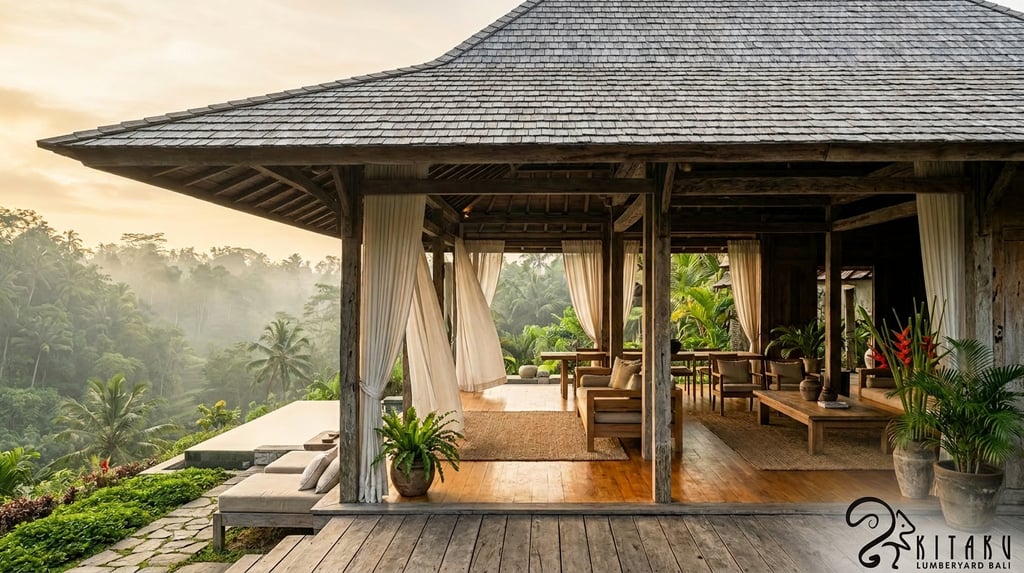
Architects are now incorporating cross-ventilation systems and wide overhangs to minimize reliance on air conditioning. Reclaimed timber ceiling structures, wide hardwood eaves, and naturally ventilated roof systems in reclaimed Ulin or Kapur are central to this strategy. The wood works with Bali's climate rather than against it.
The result is a villa that stays cooler, feels more comfortable, and costs significantly less to operate over time. For investors, this is not just an aesthetic decision. It is a financial one.
2. Humidity Resistance Built Over Decades
In Bali's humid tropical climate, moisture management is a critical design consideration. Materials that absorb and retain moisture warp, rot, develop mold, and fail structurally over time. The consequences for a luxury villa are both aesthetic and structural.
Reclaimed tropical hardwoods have a decisive advantage here. Reclaimed Bangkirai boasts excellent resistance to termites, fungi, and rot, requiring minimal maintenance thanks to its high density and natural oils. Reclaimed Teak, renowned for its high natural oil content, is naturally water-resistant and highly durable, making it perfect for decks, flooring, and luxury interiors that endure the full force of Bali's monsoon season.
These are not marketing claims. They are the result of decades of natural conditioning. A reclaimed Bangkirai beam that spent 40 years in a colonial structure has already proven its performance in exactly the conditions it will face in your villa.
3. Passive Cooling Through Intelligent Roof Design
One of the most powerful applications of reclaimed hardwood in climate-responsive villa design is the roof. Bali's tropical winds are a free energy source. Villas designed to capture airflow dramatically reduce electricity consumption while creating a more authentic living experience.
This is where Kitaru's reclaimed Ulin ironwood shingles, known as sirap, become a transformative material. Traditional sirap roofing is one of the most sophisticated passive cooling systems ever developed for tropical architecture. The overlapping shingle structure allows hot air to escape through the roof while keeping rain and UV radiation out, creating a natural chimney effect that cools interior spaces without any mechanical assistance.
Ulin naturally withstands tropical storms, termites, and humidity for 75 years or more without any treatment. It does not off-gas chemicals in the heat. It does not expand and contract in ways that compromise the roof structure. It simply performs, season after season, decade after decade.
In 2026, this kind of material intelligence is what separates truly exceptional villa design from everything else on the market.
The Architecture of the Intelligent Tropical Villa
🌴 Wide Eaves and Sheltered Terraces
The deep roof overhang is one of the signature elements of Bali's finest contemporary villas. These deep roof overhangs extend well beyond the structure, providing essential protection from the tropical elements while creating a seamless indoor-outdoor flow.
Reclaimed hardwood is the ideal material for wide eave structures. Its natural density and weather resistance allow overhangs to extend far beyond what engineered alternatives can support without warping or structural compromise. In species like Bangkirai or Ulin, the performance under continuous UV and moisture exposure is simply unmatched.
🏠 Reclaimed Wood Facades That Breathe
A fundamental shift is underway in how Bali's premier villas are designed on the outside. There is a clear departure from the glass box aesthetic, which often requires excessive cooling, in favor of wide eaves, natural cross-ventilation, and the use of reclaimed ironwood and volcanic stone.
Reclaimed timber facades in Bangkirai or Kapur create a natural barrier against solar heat gain. The dense grain of these species reflects and absorbs heat differently from glass or concrete, keeping interior temperatures more stable throughout the day. As the wood weathers naturally to its silver-grey or golden-brown tones, it becomes more beautiful with every passing season.
🪵 Exposed Beam Ceilings and Natural Ventilation
High ceilings with exposed reclaimed timber beams are a signature of the intelligent tropical villa. They serve a dual purpose: aesthetic grandeur and passive thermal performance. Hot air rises naturally toward the ceiling and escapes through ventilation gaps in the roof structure, while cooler air circulates at living level.
2026 design trends show increasing hybrid builds: concrete where necessary for durability, combined with bamboo, reclaimed timber, volcanic stone, and lime plaster for warmth and environmental performance. Reclaimed Kapur and Ulin beams are particularly valued in this context for their structural reliability and their visual character, which no factory-produced alternative can replicate.
🌊 Decking and Pool Surrounds That Perform in Any Season
The outdoor living spaces of a Bali luxury villa face the full force of the tropical climate: intense UV, monsoon rains, and constant foot traffic from bare, wet feet. The material choices here are critical.
Naturally dense and durable, reclaimed Bangkirai thrives in extreme conditions, making it a top choice for decking, pool surrounds, pergolas, and exterior structures. Its surface remains comfortable underfoot even in intense midday heat, a property that no composite decking material can match. And unlike synthetic alternatives, it improves with age rather than degrading.
🏗️ Structural Columns and Load-Bearing Elements
Reclaimed tropical hardwoods bring structural intelligence as well as aesthetic beauty to villa design. Ulin ironwood, with its extraordinary Janka hardness rating of 4,190 lbf, three times harder than teak, provides structural performance that rivals steel in appropriate applications, without the thermal conductivity issues that make metal structures uncomfortable in tropical buildings.
For elevated foundation systems, which are gaining popularity in areas like Western Bali and Tabanan for their ability to protect root systems, reduce erosion, improve drainage, and minimize flood exposure, reclaimed tropical hardwood is the material of choice for both structural integrity and visual consistency with the landscape.
The Return on Investment of Climate-Intelligent Design
The financial case for reclaimed hardwood in climate-responsive villa design goes well beyond material longevity, although longevity alone is compelling enough.
Consider the operational savings. A villa designed around passive cooling strategies, natural ventilation, and reclaimed hardwood roof systems requires dramatically less mechanical cooling. In Bali's competitive rental market, lower operating costs translate directly into better yields for owners and more competitive pricing for guests.
Consider the maintenance savings. Reclaimed Teak, Bangkirai, and Ulin require minimal maintenance by nature. There are no annual repainting cycles, no chemical treatment programs, no early replacement costs. These materials are designed by nature to outlast everything around them.
And consider the premium that discerning guests and buyers now place on authenticity. People invest in Bali for nature. Villas that disconnect from it lose their essence. A villa built with intelligent natural materials, designed to work with the tropical climate rather than fight it, delivers an experience that no glass-and-concrete alternative can replicate.
Species Guide for Climate-Responsive Villa Design
SpeciesClimate PerformanceBest Structural ApplicationReclaimed TeakHigh natural oil content, water and termite resistantFlooring, paneling, interior joineryReclaimed BangkiraiExtreme density, UV resistant, superb in wet conditionsDecking, pool surrounds, facades, pergolasReclaimed KapurTermite and fungus resistant, excellent structural integrityExposed beams, trusses, load-bearing columnsReclaimed MerantiExcellent workability, moisture stableInterior cladding, cabinetry, decorative screensReclaimed UlinHardest tropical hardwood, 75+ year untreated lifespanSirap shingles, structural columns, marine applications
Each of these species is available through Kitaru, sourced responsibly from East Kalimantan and Central Java, with full traceability documentation for architects and developers who demand accountability in their supply chain.
Beyond the Build: A Long-Term Partnership
Designing a climate-responsive villa in Bali with reclaimed tropical hardwood is not a transaction. It is a collaboration that requires deep knowledge of both the materials and the environment in which they will perform.
Kitaru Lumberyard Bali works alongside architects, interior designers, and villa developers at every stage of this process. From species selection based on specific climatic exposure, to structural suitability assessment, to surface treatment recommendations that preserve natural thermal performance, Kitaru brings expertise that no general timber supplier can offer.
The success of Bali's finest villa projects depends on working with specialists who understand the relationship between material and climate. In 2026, that relationship is everything.
Build for the Climate. Build for the Century.
Bali's tropical climate is not an obstacle to be overcome with imported technology. It is a condition to be embraced with materials that evolved alongside it over centuries.
Reclaimed tropical hardwood is not a nostalgic choice. It is the most rational, most beautiful, and most sustainable response to the design challenges that Bali's climate presents. It is a material that arrived already proven, already seasoned, already aligned with the environment in which it will spend its next century of service.
The most intelligent villas being built in Bali today are not fighting the climate. They are built from it.
Ready to design a villa that works with Bali's climate, not against it?
Kitaru offers expert consulting tailored to your architectural vision, a premium selection of reclaimed Teak, Bangkirai, Kapur, Meranti, and Ulin sourced responsibly from across the Indonesian archipelago, Ulin sirap shingles for passive-cooling roofing systems, and bespoke solutions for luxury villas, boutique resorts, and hospitality landmarks throughout Bali and beyond.
📍 Visit the Kitaru Lumberyard Bali showroom 📞 Call: +62 0823 4248 1388 (WA) 📧 Email: info@kitaru-lumberyard-bali.com 🌐 www.kitaru-lumberyard-bali.com
Let's build something intelligent, beautiful, and built for the tropics.
Visit the Showroom
Jl. Pantai Saba No.47509, Saba, Kec. Blahbatuh, Kabupaten Gianyar, Bali 80581
Contact Us
Via the Contact page
By email:
info@kitaru-lumberyard-bali.com
By phone:
(+62) 0823 4248 1388 (WA)
Showroom Hours:
Mon to Fri: 8.30AM – 4.30PM
Sat: 8.30AM – 12 noon
(closed Sundays)
Copyright© 2024-2026 PT-PMA BNM Management Solutions. All rights reserved.
Trusted source for sustainable hardwood and quality hardware. We offer reclaimed Bangkirai, Meranti, Teak, and Kapur, plus exclusive decorative pieces in reclaimed Ulin from our partners. Supplying top-tier decking, flooring, and more—get the best quality at the best price.