

New Bangkirai Hardwood in Bali: The Smart Alternative When Reclaimed Can't Meet Your Demand
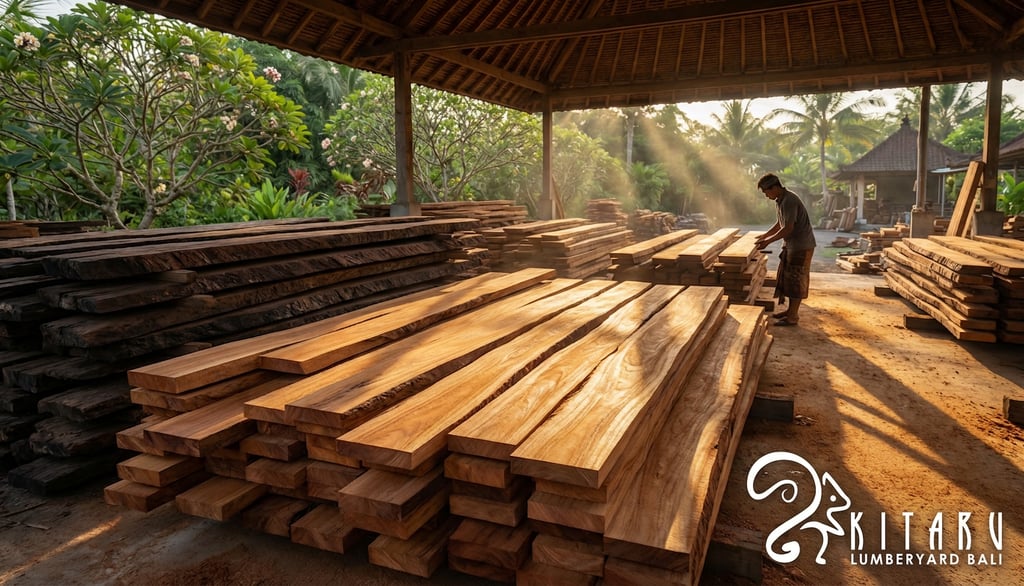
You've spec'd Bangkirai for your pool deck, your terrace, or your entire resort flooring. You know it's the right timber. Dense. Durable. Built for the tropics. But here's the problem: your project needs 200 square meters of perfectly uniform decking boards. And reclaimed Bangkirai, while exceptional, simply isn't available in that volume right now. Or your client specifically requires brand-new timber with consistent dimensions, zero nail holes, and a uniform colour tone. This is the reality of building in Bali. Reclaimed supply fluctuates. Large-scale projects demand consistency. And sometimes, new Bangkirai is the right call. This guide walks you through everything you need to know about sourcing new Bangkirai in Bali. Its properties, how it compares to reclaimed, when to choose it, and how Kitaru Lumberyard ensures every board is legally sourced and SVLK-certified.
6/1/20268 min read
What Exactly Is Bangkirai?
Bangkirai, scientifically known as Shorea laevis, belongs to the Dipterocarpaceae family. It is traded internationally under the name Yellow Balau.
Bangkirai grows across Southeast Asia, especially in Sulawesi and Kalimantan, as well as parts of Malaysia, Myanmar, Thailand, and the Philippines. The tree can reach heights of 50 metres, with a clear bole length of 35 to 40 metres and a diameter exceeding 100 centimetres.
In Indonesia, Bangkirai has been a construction staple for generations. It is mainly used for heavy-duty structures such as bridges, railway sleepers, floors, and post-and-beam buildings. A growing market for this wood is terrace and patio flooring as well as garden furniture.
For construction in Bali, Bangkirai represents that ideal middle ground. Harder and more affordable than teak, more available than ulin ironwood, and beautifully suited to outdoor tropical applications.
The Technical Profile of New Bangkirai
Understanding the numbers behind the wood helps you make a confident decision.
In terms of density, Bangkirai weighs in at 0.92 g/cm³. This places it firmly in the heavyweight category of tropical hardwoods, making it exceptionally resistant to impact and wear.
Its Janka hardness rating is 1,798 lbf. That puts it above White Oak at 1,360 lbf, Hard Maple at 1,450 lbf, and very close to Hickory at 1,820 lbf. Its strength exceeds that of oak by roughly 50 percent.
The durability class of Bangkirai heartwood is class 2 according to DIN EN 350-2, meaning it is resistant to wood-destroying fungi and termites. The above-ground life expectancy of untreated Bangkirai is at least 20 years. When maintained on a two to three-year cycle, that lifetime extends to 40 years or more.
Visually, the heartwood has a yellowish light-brown to greenish hue when fresh, often darkening to an olive brown shade over time. The grain is straight or interlocked. The surface is smooth or alternately smooth and rough due to the interlocked grain, with a naturally glossy finish.
Workability is generally good. Sawing, milling, drilling, and chiselling are straightforward, though planing can cause fibre splitting due to the interlocked grain. One important note: contact with iron will cause black stains on the wood surface, so stainless steel fasteners are always recommended.
There is also a natural characteristic worth knowing about. Bangkirai contains gum-resin ducts filled with a translucent, pale-yellow resin called damara. This seeps out when the wood is exposed to heat. It is not a defect. It is simply how Bangkirai behaves, and it can be managed with proper finishing.
The Heartwood vs. Sapwood Question
This is something every buyer should understand before ordering new Bangkirai.
Bangkirai comes in two classes. Class A is heartwood. Class B is sapwood. The difference matters enormously for durability.
The heartwood, the dense darker core of the tree, is where all the natural resistance to rot, fungi, and termites lives. The sapwood, the lighter outer layer, is significantly less durable. Its resistance to marine borers is insufficient.
Here is the catch that many buyers in Bali don't realise. None of the Indonesian timber suppliers is willing to supply Bangkirai heartwood only unless a very high price is paid. They will mix the batch with sapwood, which is pale yellow, or supply sapwood only.
This is precisely why choosing your supplier matters. At Kitaru Lumberyard, we are transparent about grading, heartwood-to-sapwood ratios, and what you are actually getting. No surprises on site.
When Does New Bangkirai Make More Sense Than Reclaimed?
At Kitaru, we always recommend reclaimed timber first. It is our core business. Reclaimed wood is salvaged from old buildings, bridges, and industrial sites, then repurposed for new projects. It reduces deforestation while offering durability and unique character that new wood often lacks.
But real-world project demands don't always align with reclaimed supply. Here are the situations where new Bangkirai becomes the practical, responsible choice.
Volume requirements
Your project calls for 150, 300, or 500-plus square metres of uniform decking. Reclaimed Bangkirai comes in batches, each with varying dimensions, lengths, and conditions. Matching that volume with consistent specs from reclaimed stock alone is often impossible.
Client specifications
Some architects and developers require brand-new timber. They want zero nail holes, zero patina, zero variation. They want boards that are perfectly uniform in colour and dimension. New Bangkirai delivers that.
Structural applications
For beams, joists, and load-bearing elements that require specific engineering grades and certified strength values, new Bangkirai from controlled harvesting offers tested, reliable mechanical properties.
Budget considerations
Reclaimed teak, for example, costs on average 30 percent more than new teak due to its aged durability and unique aesthetics. The same premium applies across species. When budget is tight but tropical performance is non-negotiable, new Bangkirai offers outstanding value.
Timeline pressure
Reclaimed sourcing can take weeks of accumulating matching stock. New Bangkirai can be ordered to spec from Kalimantan sawmills and delivered on a predictable schedule.
SVLK Certification: Why It's Non-Negotiable
When you choose new timber in Indonesia, legality isn't optional. It is the law.
SVLK stands for Sistem Verifikasi Legalitas dan Kelestarian. It is a mandatory national certification system for timber legality and sustainability in Indonesia. The certification covers the entire supply chain, from production to distribution.
What does this mean in practice? Traceability is a critical element. It involves tracking the wood from the forest where it is harvested all the way through to the point of sale. This ensures that certified timber can be traced back to its original source, confirming sustainable and legal harvesting.
For builders and developers in Bali, this matters for several reasons.
SVLK verification helps companies dramatically lower the risk of inadvertent violations of the European Union Timber Regulation, the US Lacey Act, and Australia's Illegal Logging Prohibition. If your project involves international investors, foreign buyers, or export-oriented hospitality brands, SVLK documentation is essential.
Since 2013, all timber products in Indonesia are subject to the SVLK system. Indonesia is the first and only country in the world that holds a FLEGT license, which stands for Forest Law, Enforcement, Governance, and Trade.
At Kitaru Lumberyard, every piece of new Bangkirai we supply comes with full SVLK documentation. No exceptions.
New Bangkirai Applications in Bali Construction
New Bangkirai's combination of density, hardness, and tropical resistance makes it ideal for a wide range of applications.
Pool decks and terraces are by far the most popular use. Bangkirai's natural density means it stays cooler underfoot than composite alternatives, while its resistance to moisture and UV makes it perfect for exposed outdoor areas.
For structural framing, Bangkirai-based FJL, or Finger Joint Laminate, is increasingly used in contemporary Indonesian architecture. New Bangkirai's consistent grading makes it ideal for engineered structural applications like main columns and beams.
Indoor and outdoor flooring is another strong application. The glossy surface and warm tones of freshly milled Bangkirai create a striking visual impact, especially in open-plan villa designs.
Architectural cladding, privacy screens, and decorative facades also benefit from new Bangkirai's uniform dimensions. Where consistent line spacing is essential, new Bangkirai delivers.
For marine and coastal use, Bangkirai easily withstands constant salt spray. Beachfront restaurants, jetties, and coastal pathways are among the top performers for this species.
How New Bangkirai Ages in Bali's Climate
One of the most common questions we hear is: what will my new Bangkirai deck look like in two years?
When exposed to the elements, Bangkirai greys very quickly. This silver-grey patina is a natural oxidation process and does not indicate decay or structural weakness. Many Bali architects actually prefer this weathered look. It blends beautifully with natural stone, concrete, and tropical landscaping.
If you prefer to maintain the original warm brown tone, an annual application of UV-protective hardwood oil will preserve the colour. Clean the wood regularly with a soft brush and mild soap solution, then treat it annually with a suitable hardwood oil for optimal protection.
One thing to expect: Bangkirai will show tiny cracks over time due to its natural tendency to shrink slightly, even after kiln drying. It is therefore less suitable for doors and windows. But if you accept those tiny cracks, which give it an antique character, Bangkirai is an extremely durable hardwood that will last a lifetime.
New Bangkirai vs. Reclaimed Bangkirai: An Honest Comparison
In terms of appearance, new Bangkirai offers a uniform, consistent look with warm golden-brown tones, no nail holes, and no patina. Reclaimed Bangkirai has character, history, and variation. Each board tells a story.
Dimensional consistency favours new Bangkirai. It can be ordered to exact specifications. Reclaimed boards vary in width, length, and thickness, requiring more on-site adaptation.
Seasoning is where reclaimed has the edge. Reclaimed Bangkirai has been naturally seasoned over decades, meaning less movement after installation. New Bangkirai requires proper kiln drying and acclimatisation before installation to minimise shrinkage and warping.
Environmental impact clearly favours reclaimed. Zero new trees harvested. New Bangkirai, when SVLK-certified, comes from managed concessions with replanting obligations, but it still involves fresh harvesting.
Availability favours new Bangkirai. It can be sourced in large, consistent volumes. Reclaimed Bangkirai supply fluctuates based on demolition projects and salvage opportunities.
Price generally favours new Bangkirai. It is more affordable per cubic metre. Reclaimed commands a premium due to scarcity, character, and proven long-term stability.
Installation Tips for New Bangkirai in Bali
Getting the most out of your new Bangkirai starts with proper installation.
Always pre-drill. Bangkirai is extremely dense. Driving screws without pre-drilling will split the wood or strip the screw heads. Use high-quality HSS drill bits.
Use stainless steel hardware only. Standard steel or iron fasteners will react with the wood's tannins and create black staining. Stainless steel 316, marine grade, is the standard for Bali coastal projects.
Allow for expansion gaps. New Bangkirai will move more than reclaimed during its first year. Leave 5 to 8 millimetres between boards for airflow and expansion in tropical humidity.
Acclimatise before installation. Store your Bangkirai boards on-site, protected from direct rain but exposed to ambient humidity, for at least 7 to 14 days before installation. This allows the wood to reach equilibrium moisture content.
Apply end-grain sealer. The cut ends of Bangkirai boards absorb moisture faster than the face, which can cause end-checking, or splitting. A quality end-grain sealer applied immediately after cutting prevents this.
Ensure ventilation underneath. Leave at least 50 millimetres of airflow beneath your decking structure. In Bali's humidity, trapped moisture under a deck is the fastest path to premature decay, even for Bangkirai.
Why Source New Bangkirai From Kitaru Lumberyard?
Kitaru is a Bali-based lumberyard and trusted supplier of sustainably sourced wood. We provide architects, builders, and homeowners with premium, ethically sourced hardwood lumber for residential, commercial, and custom projects. Our hardwoods are carefully selected to deliver both durability and environmental responsibility.
While reclaimed timber remains our foundation, we understand that real projects have real constraints. That is why we also supply SVLK-certified new Bangkirai directly from verified concessions in Kalimantan, the heartland of Indonesian Bangkirai production.
When you order new Bangkirai from Kitaru, you get full SVLK documentation and traceability for every board. Transparent grading with clear heartwood-to-sapwood information. Custom milling to your exact specifications, including thickness, width, length, and profile. Expert advice on species selection, installation methods, and finishing. And a price-match guarantee. We are so confident in our prices that if you find a cheaper offer elsewhere, we will match it and slash an extra 5 percent off. No hassle, no tricks. Just the best deals on high-quality tropical hardwood.
Kitaru Lumberyard Bali is more than a wood supplier. We are partners for architects, designers, and developers who demand materials that carry both legacy and resilience.
The Bottom Line
New Bangkirai is not a compromise. It is a strategic choice for projects where volume, uniformity, budget, or timeline make reclaimed impractical.
With a Janka hardness of 1,798 lbf, a density of 0.92 g/cm³, durability class 2 resistance to fungi and termites, and the ability to withstand salt spray, monsoons, and decades of barefoot traffic, Bangkirai remains one of the most reliable tropical hardwoods you can specify for construction in Bali.
The key is sourcing it responsibly. SVLK certification. Transparent grading. A supplier who tells you exactly what you are getting.
That is what Kitaru delivers.
Ready to Discuss Your Bangkirai Needs?
Whether your project calls for reclaimed character or new-timber consistency, our team will help you find the right solution.
Visit the Kitaru Lumberyard showroom to see both reclaimed and new Bangkirai samples, compare grades, and get expert advice tailored to your project.
The Kitaru Lumberyard warehouse, sales office, and showroom are located at Jl. Pantai Saba No.47509, Saba, Kec. Blahbatuh, Kabupaten Gianyar, Bali 80581. Open Monday to Friday from 8:30 AM to 4:30 PM, and Saturday from 8:30 AM to 12:00 PM.
Email: info@kitaru-lumberyard-bali.com WhatsApp: (+62) 0823 4248 1388
Tell us about your project. We will tell you exactly which Bangkirai, reclaimed or new, will serve it best.
Visit the Showroom
Jl. Pantai Saba No.47509, Saba, Kec. Blahbatuh, Kabupaten Gianyar, Bali 80581
Contact Us
Via the Contact page
By email:
info@kitaru-lumberyard-bali.com
By phone:
(+62) 0823 4248 1388 (WA)
Showroom Hours:
Mon to Fri: 8.30AM – 4.30PM
Sat: 8.30AM – 12 noon
(closed Sundays)
Copyright© 2024-2026 PT-PMA BNM Management Solutions. All rights reserved.
Trusted source for sustainable hardwood and quality hardware. We offer reclaimed Bangkirai, Meranti, Teak, and Kapur, plus exclusive decorative pieces in reclaimed Ulin from our partners. Supplying top-tier decking, flooring, and more—get the best quality at the best price.