


Reclaimed Hardwood Decking vs. Composite in Bali
You're about to build a pool deck, a terrace, or a wraparound veranda for your Bali villa. Your contractor mentions two options: reclaimed hardwood and composite (WPC). Both sound good. Both claim to be durable. Both say they're "eco-friendly." So which one actually performs in Bali's brutal tropical climate the relentless UV, the monsoons, the salt air, the humidity that never lets up? Pick the wrong material, and you'll be replacing boards within 5 years. Pick the right one, and your deck becomes a lasting asset that adds beauty, value, and function to your property for decades. This article gives you a no-nonsense, side-by-side comparison so you can make a decision based on facts, not marketing.post description.
5/25/20266 min read
What Is Reclaimed Hardwood Decking?
Reclaimed hardwood decking uses timber salvaged from old structures — bridges, warehouses, traditional houses, and industrial sites — then re-milled into premium deck boards.
In Bali, the most common species used for reclaimed decking are Bangkirai (Yellow Balau), a beautiful wood with a classy texture and smooth surface, prized for its hardness and even grain. Then there's Ulin (Ironwood), with a Janka rating of 4,190 lbf — three times harder than teak, naturally impervious to saltwater, shipworms, and tidal erosion, withstanding tropical storms, termites, and humidity for 75+ years untreated. Teak (Jati Bekas) is renowned for its high natural oil content, making it naturally water-resistant, termite-resistant, and highly durable. Finally, Kapur and Meranti are versatile options offering excellent value with solid tropical performance.
Why "Reclaimed" Matters
Reclaimed wood is salvaged from old buildings, bridges, and industrial sites, then repurposed for new projects. Unlike freshly harvested timber, reclaimed hardwood has already been naturally seasoned over decades — meaning less warping, less shrinking, and proven structural integrity.
Reclaimed teak from Java remains the gold standard, favoured for its stability over new wood.
What Is Composite (WPC) Decking?
WPC stands for Wood Plastic Composite. It's made from a blend of wood fibers and recycled plastics. It's engineered to mimic the look of natural wood while offering a "low maintenance" promise.
WPC in the Bali Market
Bali's growing resort industry drives demand for durable, low-maintenance outdoor flooring. WPC decking is becoming a popular choice for resorts due to longevity, UV resistance, and non-slip surfaces. Leading manufacturers supply raw boards and full installation systems, with warranties up to 30 years.
Sounds great on paper. But there are critical trade-offs you need to know.
The 6 Key Factors — Head to Head
Heat Retention (The Barefoot Test)
This is the dealbreaker most people discover too late.
Composite decking, at its core, is plastic, which means it can get uncomfortably hot under direct sunlight. This isn't just about the discomfort of walking barefoot on a hot surface but also about the material's longevity.
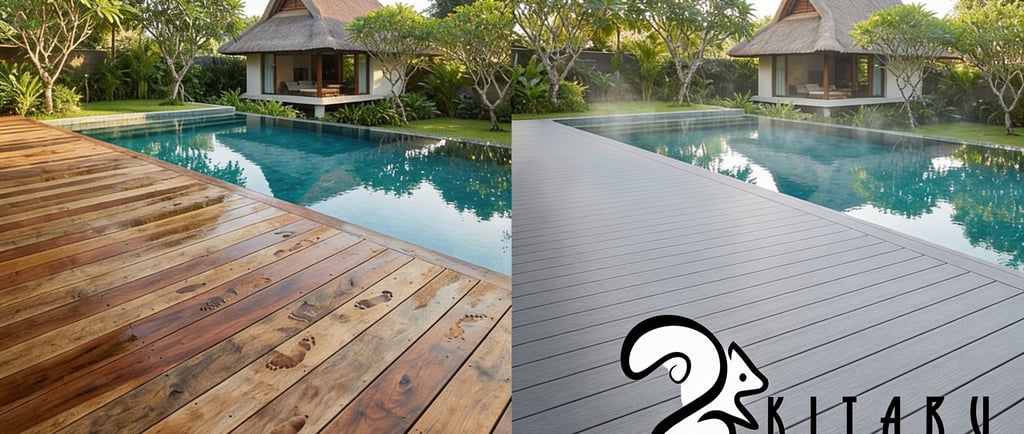
In Bali, where pool decks sit in full sun for 8+ hours a day, WPC surface temperatures can exceed 65°C (150°F). Natural hardwood stays noticeably cooler because wood doesn't absorb and radiate heat the way plastic-based materials do.
Winner: Reclaimed Hardwood.
Durability in Tropical Conditions
Reclaimed wood is especially beneficial in regions with high humidity, like Bali, where tropical hardwoods like ulin perform better than pine or cedar.
Tropical hardwoods, with their natural density and moisture resistance, are well-suited for areas with high humidity, frequent rainfall, or extreme temperature fluctuations. They resist rot, decay, and insect damage.
WPC resists moisture well but can warp under extreme heat cycles, scratch easily on the surface layer — exposing the inner core to the elements — and sag between joists if spacing isn't reduced, which increases construction costs.
Reclaimed Ulin, Bangkirai, and Teak have proven themselves over decades in Bali's most demanding environments — poolsides, beachfront resorts, open-air restaurants.
Winner: Reclaimed Hardwood.
Aesthetics and Character
There is no debate here. Nothing compares to the warmth, grain variation, and soul of real reclaimed tropical hardwood.
A wooden deck features warm, textured planks with natural grain patterns. Reclaimed ironwood decks develop a stunning grayish-brown patina over time, adding a rustic charm that blends seamlessly with nature. This fits perfectly with the Japanese-inspired Wabi-Sabi design trend that is reshaping Bali's luxury architecture — raw concrete, reclaimed teak, neutral linen, and handmade ceramics.
WPC can mimic the look of wood, but up close it lacks the depth, texture, and authenticity that high-end Bali architecture demands. Composite decking combines wood fibers and plastic, offering low maintenance but a synthetic appearance.
Sustainable and eco-forward materials like reclaimed wood, natural stone, and bamboo reflect the island's environment — and this is what Bali's top architects and designers are specifying in 2026.
Winner: Reclaimed Hardwood.
Environmental Impact
This is where the conversation gets interesting.
WPC markets itself as "eco-friendly" because it uses recycled plastics. But it ends up in landfills where it does not degrade. In the event of a storm, pieces of composite decking can be swept out to sea, causing environmental damage that lasts for millennia. Polyethylene, polypropylene, and polyvinyl chloride do not grow on trees. These are petroleum products that rely upon one of the most environmentally unfriendly industries around.
Reclaimed hardwood, on the other hand, requires zero new tree harvesting. It gives existing timber a second life. Reclaimed teak is high-quality teak wood salvaged from old structures, maintaining its natural beauty while promoting environmental sustainability. In Bali's high-end construction market, only timbers with a certified SVLK (Timber Legality Verification System) license are accepted — ensuring full traceability and legality.
Winner: Reclaimed Hardwood.
Maintenance
Let's be honest — this is the one category where WPC has a real advantage.
Composite decking requires no oiling, no sanding, and only occasional soap-and-water cleaning.
Reclaimed hardwood decking requires annual oiling (recommended, not mandatory) to preserve color, periodic cleaning to remove mold or algae, and re-sanding every few years if you want to maintain the original tone.
However, ulin ironwood is almost maintenance-free. Its natural oils and density protect it from tropical decay. An annual inspection for alignment and debris removal is usually sufficient to guarantee decades of service.
Many homeowners in Bali choose to let their hardwood deck weather naturally — the silver-grey patina is not a defect; it's a feature.
Winner: WPC (slight edge).
Long-Term Cost
WPC boards are often cheaper per square meter at purchase. But factor in the recommended closer spacing of joists to prevent sagging (which increases construction costs), the shorter lifespan (15 to 25 years vs. 50 to 75+ years for Ulin or Bangkirai), and the replacement costs — composite can't be sanded or refinished, so damaged boards must be fully replaced.
Reclaimed hardwood may cost more upfront, but over a 30-year horizon, it is almost always the more cost-effective investment.
Winner: Reclaimed Hardwood (long-term).
Quick Comparison
Heat Retention: Reclaimed hardwood stays cool barefoot. WPC gets hot in direct sun.
Durability in the Tropics: Reclaimed hardwood lasts 50 to 75+ years. WPC lasts 15 to 25 years.
Aesthetics: Reclaimed hardwood is authentic and unique. WPC has a synthetic look.
Eco-Impact: Reclaimed hardwood is circular with zero deforestation. WPC is plastic-based and non-degradable.
Maintenance: Reclaimed hardwood needs optional annual oiling. WPC only needs washing.
Upfront Cost: Reclaimed hardwood is higher. WPC is lower.
Total Cost over 30 years: Reclaimed hardwood is lower. WPC is higher due to replacements.
What Bali's Top Architects Are Choosing in 2026
The trend is clear. The most successful builds in 2026 use a "hybrid materiality" strategy — reinforced concrete only for the foundation and wet areas, rammed earth for thermal-mass walls, and reclaimed teak or bamboo for high-span roofing.
Eco-conscious design isn't just a trend anymore. It's the new standard. Villas built in 2025 and 2026 are using reclaimed wood, sustainable bamboo, solar energy, and rainwater collection systems. Guests and buyers now expect properties to be eco-friendly.
For pool decks, terraces, and outdoor living areas specifically, reclaimed Bangkirai, Ulin, and Teak remain the go-to materials for architects who prioritize long-term performance, authenticity, and environmental responsibility.
Where to Source Premium Reclaimed Decking in Bali
Kitaru is a Bali-based lumberyard and trusted supplier of sustainably sourced reclaimed wood. We provide architects, builders, and homeowners with premium, ethically sourced hardwood lumber for residential, commercial, and custom projects. Our reclaimed teak, ironwood, and other hardwoods are carefully selected to deliver both durability and environmental responsibility.
At Kitaru Lumberyard Bali, you'll find reclaimed Bangkirai decking — the workhorse of tropical outdoor installations. Reclaimed Teak decking offering timeless beauty with proven stability. Reclaimed Kapur and Meranti for excellent value and impressive performance. Full hardware supply including stainless steel screws, fittings, and mounting plates. And expert guidance — our team helps you choose the right species, dimensions, and finish for your specific project.
Unlike many suppliers, we provide verified origin documentation, ensuring true sustainability and ethical sourcing. No more uncertainty — just authentic, reclaimed tropical hardwood you can trust.
So, Which Decking Should You Choose?
If you want low maintenance above all else and your deck is in a shaded, low-traffic area, composite (WPC) can work.
But if you're building in Bali — where the sun hits hard, where barefoot living is the norm, where aesthetic authenticity matters, and where your villa needs to stand the test of tropical time — reclaimed hardwood wins on nearly every front.
It's cooler underfoot. It's stronger. It's more beautiful. It's genuinely sustainable. And over 30 years, it costs less.
Ready to Choose the Right Decking for Your Bali Project?
Visit the Kitaru Lumberyard showroom to see and touch our reclaimed Bangkirai, Teak, Kapur, and Meranti decking in person.
The Kitaru Lumberyard warehouse, sales office, and showroom are located at Jl. Pantai Saba No.47509, Saba, Kec. Blahbatuh, Kabupaten Gianyar, Bali 80581. Open Monday to Friday from 8:30 AM to 4:30 PM, and Saturday from 8:30 AM to 12:00 PM.
Email: info@kitaru-lumberyard-bali.com WhatsApp: (+62) 0823 4248 1388
Get a free consultation and quote — tell us about your project today.
Visit the Showroom
Jl. Pantai Saba No.47509, Saba, Kec. Blahbatuh, Kabupaten Gianyar, Bali 80581
Contact Us
Via the Contact page
By email:
info@kitaru-lumberyard-bali.com
By phone:
(+62) 0823 4248 1388 (WA)
Showroom Hours:
Mon to Fri: 8.30AM – 4.30PM
Sat: 8.30AM – 12 noon
(closed Sundays)
Copyright© 2024-2026 PT-PMA BNM Management Solutions. All rights reserved.
Trusted source for sustainable hardwood and quality hardware. We offer reclaimed Bangkirai, Meranti, Teak, and Kapur, plus exclusive decorative pieces in reclaimed Ulin from our partners. Supplying top-tier decking, flooring, and more—get the best quality at the best price.