


The Golden Ratio in Wood How Nature's Perfect Proportion Shaped Timber Construction From Ancient Indonesia
f you look closely at the spiral of a pinecone or the arrangement of leaves on a stem, you are witnessing a silent, mathematical masterpiece. This is the Golden Ratio, or Phi ($\phi \approx 1.618$), a number that has fascinated mathematicians, artists, and architects for millennia. Often associated with the Parthenon or Renaissance masterpieces, this "divine proportion" is far more than a human invention; it is the fundamental blueprint of the natural world. Nowhere is this more evident than in the material that has sheltered humanity for centuries: wood. From the internal biological structure of a living tree to the ancient timber palaces of Indonesia, the Golden Ratio serves as the bridge between organic growth and architectural permanence.
3/30/20262 min read
The Biological Blueprint: How Trees Use Phi
Before a piece of timber ever reaches a carpenter’s workshop, it is already a product of rigorous geometric optimization. Trees do not grow randomly; they are governed by the need for maximum efficiency.
One of the most striking examples is phyllotaxis—the arrangement of leaves, scales, and branches. To ensure that every leaf receives maximum sunlight and that rainfall is distributed effectively to the roots, trees utilize the Golden Angle of approximately 137.5°. By spiraling at this specific angle, no new leaf perfectly overlaps the one directly below it, creating an optimized "packing" system that prevents self-shading.
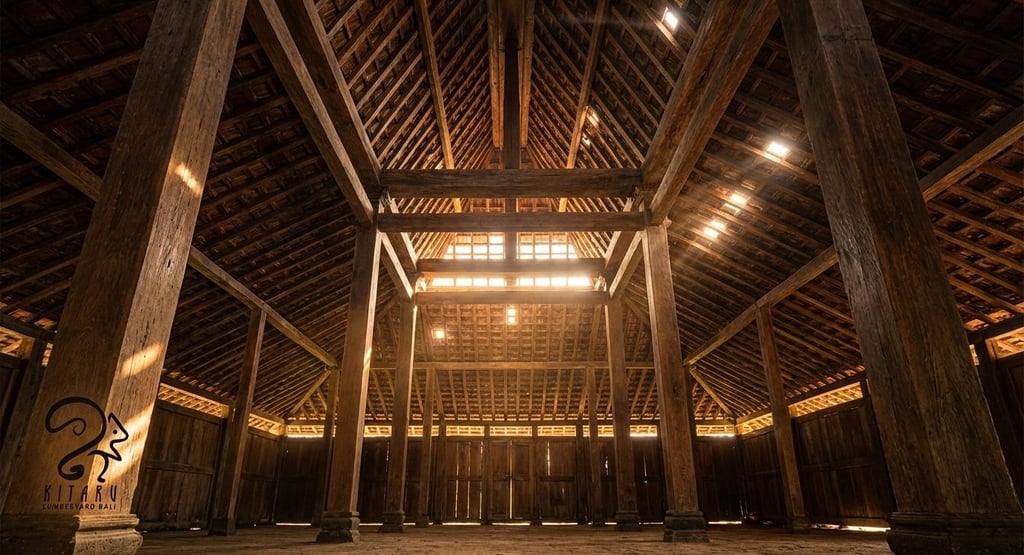
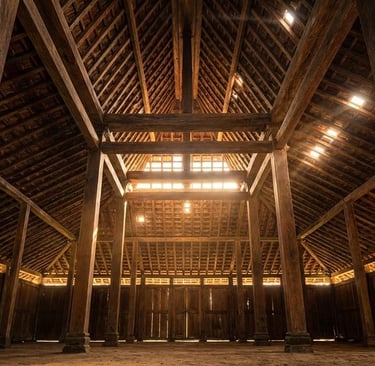
Architectural perspective: A traditional Indonesian Joglo roof structure, illustrating the application of the Golden Ratio in structural design.
The Wisdom of the Archipelago: Petungan and Gegulak
While Western scholars were codifying the Golden Ratio in textbooks, ancient Indonesian builders were applying these same principles through sophisticated traditional systems of measurement and numerology. In the archipelago, architecture was never seen as a conquest over nature, but as a harmonious extension of it.
In Java, builders utilized the Petungan system. Recorded in the Primbon (traditional manuals of knowledge), Petungan is a complex numerical framework used to determine the dimensions of Rumah Joglo and Limasan houses. Using formulas like 5n + p to calculate length-to-width ratios, artisans ensured spiritual and aesthetic "goodness." These calculations frequently resulted in proportions mirroring the Golden Rectangle, creating spaces that feel inherently balanced and "right" to the human eye.
In Bali, the approach was even more intimate through the Gegulak system. This is an anthropometric method where measurements are derived from the body of the house owner—the span of a hand (nyari), the length of a foot, or the reach of an arm (depa).
Sacred Mathematics and the Living Wood
The connection between Indonesian timber construction and the Golden Ratio is also visible in the sacred geometry of stone Candi (temples), which influenced vernacular wood architecture. The 4:6:9 ratio system found at Borobudur creates a staged, rhythmic aesthetic that parallels the Golden Section.
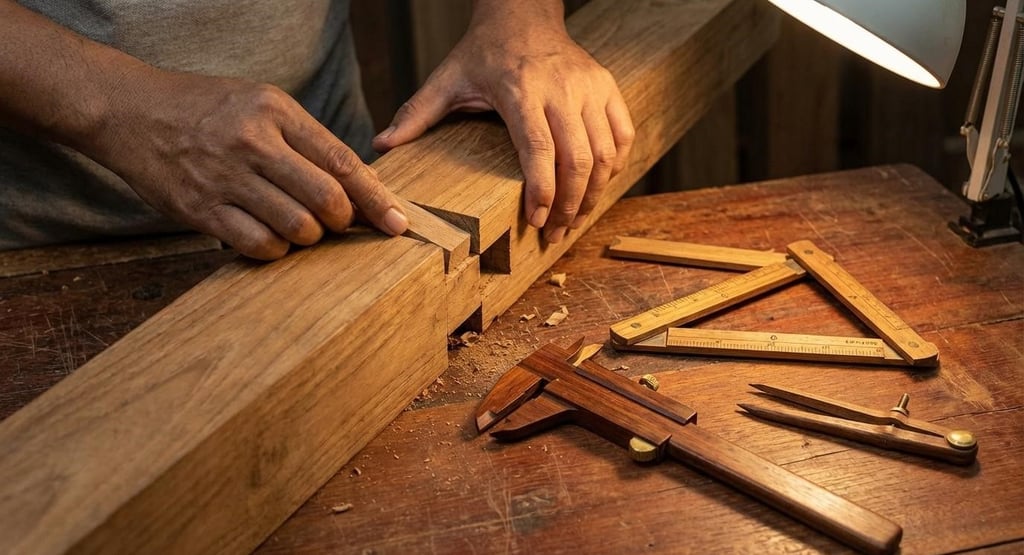
Practical Application: Precision of Indonesian timber joinery, showcasing the craftsman's use of perfect proportions.
For the Indonesian artisan, these proportions were more than just aesthetics; they were a spiritual necessity. The philosophy of Bhuana Alit (the Microcosm/human world) versus Bhuana Agung (the Macrocosm/universe) dictated that for a home to be safe and harmonious, it must resonate with the proportions of the universe.
This was further codified in the Asta Kosala-Kosali, the architectural scriptures of Bali. These texts treat timber as a living entity. Builders believed that by cutting and joining wood at specific intervals aligning with natural ratios they could maintain the wood's urip (life force).
A Legacy for Modern Construction
Today, as we move toward sustainable architecture and mass timber construction, the lessons from ancient Indonesia and the biological structure of trees are more relevant than ever. Modern engineers are rediscovering that nature’s proportions are not just beautiful they are structurally superior. By understanding the Golden Ratio in wood, we learn that the most resilient structures are those that mimic the growth patterns of the forest.
Visit the Showroom
Jl. Pantai Saba No.47509, Saba, Kec. Blahbatuh, Kabupaten Gianyar, Bali 80581
Contact Us
Via the Contact page
By email:
info@kitaru-lumberyard-bali.com
By phone:
(+62) 0823 4248 1388 (WA)
Showroom Hours:
Mon to Fri: 8.30AM – 4.30PM
Sat: 8.30AM – 12 noon
(closed Sundays)
Copyright© 2024-2026 PT-PMA BNM Management Solutions. All rights reserved.
Trusted source for sustainable hardwood and quality hardware. We offer reclaimed Bangkirai, Meranti, Teak, and Kapur, plus exclusive decorative pieces in reclaimed Ulin from our partners. Supplying top-tier decking, flooring, and more—get the best quality at the best price.