


The Sustainable Luxury of Reclaimed Bankirai: Why It's the Ultimate Choice for Modern Decking
Introduction: The Rise of Circular Luxury There is a quiet revolution unfolding in outdoor design. A new generation of homeowners, architects, and sustainable builders are rejecting the binary choice between beauty and responsibility. They are demanding materials that perform impeccably, age gracefully, and carry a story that extends far beyond the showroom floor. Welcome to the era of Circular Luxury — where the most prestigious material in your landscape isn't the newest. It's the one with the deepest history.
3/9/20267 min read
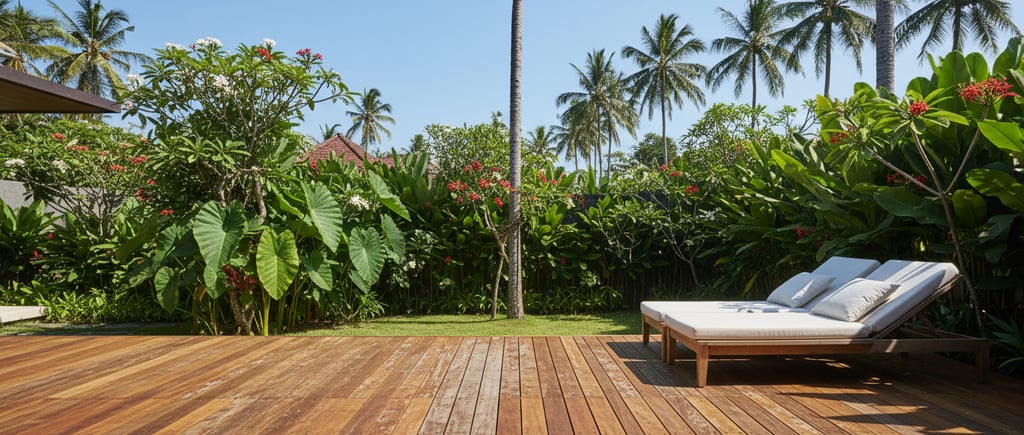
Introduction: The Rise of Circular Luxury
There is a quiet revolution unfolding in outdoor design. A new generation of homeowners, architects, and sustainable builders are rejecting the binary choice between beauty and responsibility. They are demanding materials that perform impeccably, age gracefully, and carry a story that extends far beyond the showroom floor. Welcome to the era of Circular Luxury — where the most prestigious material in your landscape isn't the newest. It's the one with the deepest history.
At the very centre of this movement stands Reclaimed Bankirai — a premium Southeast Asian hardwood salvaged from decommissioned bridges, old wharves, and retired industrial structures. It offers the same extraordinary structural performance that made it a construction legend in its first life, but now arrives with a drastically lower carbon footprint, an unreplicable weathered aesthetic, and the unassailable moral clarity of knowing that no new trees were felled for your project.
For those seeking the finest in sustainable decking materials, Reclaimed Bankirai represents the rare convergence of engineering-grade performance and environmental stewardship.
What Is Bankirai? A Botanical Powerhouse
Bankirai (Shorea laevis) is a deciduous tree of the Dipterocarpaceae family, traded internationally under the name Yellow Balau. It grows across Southeast Asia, notably in Sulawesi and Kalimantan, as well as in Myanmar, Thailand, and the Philippines.
These are not modest trees. Shorea laevis can reach up to 75 metres tall, with a branchless bole stretching 18 to 27 metres and a diameter of up to 210 cm, supported by prominent buttresses up to 6 metres high. This immense growth produces timber of extraordinary density and resilience.
For decades, Bankirai has been the gold standard for the most demanding structural applications on earth. Its main uses have traditionally been in particularly heavy-duty structures, such as bridges, railway sleepers, and industrial floors. Balau wood is a hardwood with excellent strength (D70 rating) and durability, with its high density admired across the civil, marine, and building industries.
It is precisely because Bankirai was trusted to hold bridges over rivers and withstand decades of marine exposure that its reclaimed form is so structurally valuable today. The wood has already proven itself under the most punishing conditions imaginable.
The Environmental Case for Reclaimed Timber
Before we discuss performance, let us be direct about the stakes. Shorea laevis is considered Vulnerable due to deforestation for agriculture and logging for its timber. Every plank of new-growth Bankirai extracted from primary forest accelerates this threat.
Reclaimed Bankirai fundamentally changes this equation. It is essential to understand the distinction: reclaimed timber is not the same as recycled timber. Recycled wood is often ground down into chips, particle board, or mulch — a process that destroys both its structural integrity and its stored carbon. Reclaimed timber, by contrast, preserves the original material in its solid form, re-milling it into new planks while retaining its full mechanical properties. To truly sequester carbon, it is essential to focus on the complete reuse of timber products — maintaining a wooden beam as a wooden beam preserves its carbon storage capacity. When timber is repurposed into products like particleboard, there is a loss of energy and carbon, making the process more of an energy cascade rather than a closed-loop cycle.
The benefits for eco-friendly patio design and sustainable construction are substantial:
Zero new deforestation. Not a single tree is felled. The timber is sourced from structures that have reached the end of their functional life — carefully selected from disused boats, bridges, or warehouses and turned into beautiful solid timber products including decking and flooring.
Preserved carbon storage. The carbon absorbed by the tree during its growth remains locked within the wood for another generation of use, rather than being released through decomposition or incineration.
Lower embodied energy. Reclaimed timber eliminates the energy costs of logging, primary milling, and long-distance transport of raw logs from forest to processing facility.
Contribution to LEED and green building credits. Specifying reclaimed materials can directly contribute to Material & Resources credits in LEED-certified projects, supporting reduced environmental impact targets.
Buildings and the construction sector together account for about 39% of the global energy-related CO₂ emissions. Every material decision matters. Choosing reclaimed Bankirai is not a compromise — it is a strategic reduction of your project's embodied carbon.
Unmatched Durability and Stability: Decades of Natural Seasoning
Here is where Reclaimed Bankirai delivers a technical advantage that new timber simply cannot match.
Bangkirai (Yellow Balau) has a high strength and durability factor, is hard and heavy with high stiffness and shock resistance. One of its most remarkable features is its excellent durability — it belongs to durability class 1, which means it has a lifespan of over 25 years, even in ground contact, making it ideal for outdoor applications.
Its technical profile as a durable outdoor flooring solution includes:
Fungal resistance: The heartwood is resistant to wood-destroying fungi (durability class 2 per DIN EN 350-2) and termites.
Dimensional stability: Since Bankirai wood is very dense, it is resistant to warping and cracking, maintaining its shape and appearance unlike other woods that warp due to temperature changes.
Marine-grade performance: Bankirai possesses enough natural durability for use class 5 — wood permanently or regularly submerged in salt water or brackish water — due to its high specific gravity and high silica content.
Fire resistance: It holds a Class A Flame Spread Rating, the same as concrete and steel.
The Critical Advantage of Pre-Seasoned Timber
New ("green") Bankirai requires careful and slow kiln drying. It requires care in drying as splitting and cracking is known to occur. Balau dries slowly with moderate to severe end checks and slight to severe splits.
Reclaimed Bankirai has already undergone this process — not in a kiln for weeks, but in service for decades. Twenty, thirty, or even fifty years of gradual moisture cycling in a bridge or wharf has brought the wood to a state of deep, complete equilibrium. The internal stresses that cause cupping, twisting, and checking in new timber have long since resolved. The result is a plank of exceptional dimensional stability — one that has already adapted to the most extreme conditions and proven it will not move.
This is why architects and builders pursuing tropical hardwood alternatives increasingly view reclaimed Bankirai not as a second choice, but as a superior choice.
Aesthetic Appeal: Beauty That Cannot Be Manufactured
New Bankirai is handsome. Reclaimed Bankirai is captivating.
The heartwood of fresh Bankirai has a yellowish light-brown to greenish hue that often darkens to an olive brown shade. Over years of exposure, something remarkable happens. If left untreated, Bangkirai will gradually age to a lustrous silver-grey. This silvering is not degradation — it is a surface patina caused by UV exposure, affecting only the outermost fibres while the structural core remains fully intact.
Reclaimed planks arrive with this patina already established, along with character marks that are impossible to replicate artificially:
Bolt holes and fastener indentations from their previous structural life, offering an authentic industrial-chic texture.
Subtle surface weathering that creates depth and variation across each board.
Tonal diversity ranging from deep warm browns at freshly re-milled faces to the iconic silver-grey on weathered surfaces.
These aren't imperfections. They are the provenance of the material — visible proof of its history and resilience. For designers seeking to create outdoor spaces with genuine narrative and soul, Reclaimed Bankirai delivers a character that no factory finish can achieve. Each plank tells a story of infrastructure that served faithfully for decades — now reborn as the floor beneath your feet.
Maintenance and Longevity: A Practical Guide
One of the most appealing aspects of Bankirai for homeowners seeking sustainable decking materials is its low-maintenance nature. With reclaimed stock, you have two primary pathways:
Option 1: Oil to Preserve Warm Tones
Application of oil is necessary at least once a year or even several times, depending on location and weather conditions. A high-quality penetrating hardwood oil will restore and maintain the rich brown tones. Check in advance whether the oil is suitable for the type of wood used.
Option 2: Let It Silver Naturally
If you prefer the distinguished silver-grey aesthetic, simply let nature take its course. When exposed to the elements, Bangkirai, like many other tropical timbers, greys very quickly. This patina is purely cosmetic and does not affect structural integrity.
General care tips:
After winter, clean your decking against moss, which represents an increased slippery risk. Never clean with a high-pressure jet.
Use stainless steel fixings exclusively. If fixings other than stainless steel are used, there is a risk of permanent spotting and corrosion stains appearing on the surface due to naturally occurring acidic oils.
At a Glance: Reclaimed Bankirai vs. New Bankirai vs. Composite Decking
FeatureReclaimed BankiraiNew BankiraiComposite DeckingDurability Class1–2 (proven in service)1–2 (rated)Varies by manufacturerDimensional StabilityExceptional (decades seasoned)Requires careful dryingGenerally stableAesthetic CharacterUnique patina, history marksUniform, fresh tonesManufactured, repetitiveEnvironmental ImpactZero new deforestation; low embodied carbonDepends on certification; higher embodied energyPetroleum-based polymers; non-biodegradableCarbon StorageExtended (second life cycle)Present (first life cycle)NoneFire RatingClass A (same as concrete/steel)Class AVaries; many are combustibleLifespan25+ additional years25–30+ years15–25 years typicallyMaintenanceAnnual oil or natural silveringAnnual oil or natural silveringLow, but no refinishing optionStory & ProvenanceRich, authentic heritageNoneNoneLEED ContributionYes (reclaimed material credit)Possible (if FSC-certified)Limited
The verdict is clear. Composite decking trades soul for convenience. New Bankirai offers performance but at an environmental cost. Reclaimed Bankirai delivers the full package — the durability, the beauty, the sustainability credentials, and a narrative depth that elevates every project it touches.
Conclusion: Choose a Deck With a History
The most responsible material choice is not always the newest. Sometimes, the most prestigious, enduring, and environmentally sound decision is to give extraordinary wood a second life.
Reclaimed Bankirai is not a trend. It is the logical conclusion of a design philosophy that values longevity over disposability, authenticity over imitation, and stewardship over extraction. It is a material that has already withstood decades of the harshest conditions nature and industry can produce — and emerged ready for decades more.
For the eco-conscious homeowner, it means a deck you can be genuinely proud of. For the architect or designer, it offers a material with both technical rigour and an irreplaceable narrative. For the sustainable builder, it is a direct, measurable reduction in the embodied carbon of every project.
Your next outdoor space deserves more than a surface. It deserves a story.
📥 Ready to Specify Reclaimed Bankirai for Your Next Project?
Consult with a reclaimed timber specialist today to explore available stock, dimensions, and grading options. Whether you are designing a private villa terrace, a boutique hotel deck, or a coastal boardwalk, Reclaimed Bankirai can be sourced and milled to your exact specifications.
Visit the Showroom
Jl. Pantai Saba No.47509, Saba, Kec. Blahbatuh, Kabupaten Gianyar, Bali 80581
Contact Us
Via the Contact page
By email:
info@kitaru-lumberyard-bali.com
By phone:
(+62) 0823 4248 1388 (WA)
Showroom Hours:
Mon to Fri: 8.30AM – 4.30PM
Sat: 8.30AM – 12 noon
(closed Sundays)
Copyright© 2024-2026 PT-PMA BNM Management Solutions. All rights reserved.
Trusted source for sustainable hardwood and quality hardware. We offer reclaimed Bangkirai, Meranti, Teak, and Kapur, plus exclusive decorative pieces in reclaimed Ulin from our partners. Supplying top-tier decking, flooring, and more—get the best quality at the best price.