


Your Joglo, Dismantled in Java and Reassembled on Your Land in Bali: The Complete Guide
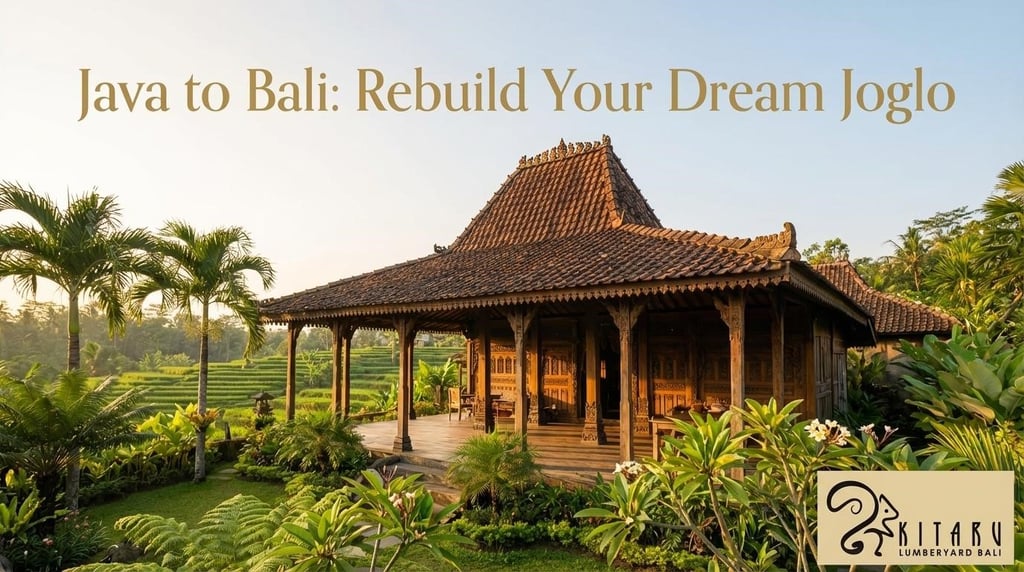
Heritage, Logistics & Craftsmanship How to Bring a Piece of Javanese History to Your Bali Property Introduction Imagine living under a roof that was built before your great-grandparents were born. A structure held together not by nails or bolts, but by the precision of Javanese master carpenters who fasted and meditated before cutting a single beam. This is the joglo the most prestigious form of traditional Javanese architecture. These traditional 19th century vernacular houses were wooden frame buildings designed to represent the best of human traits. Crafted from premium teakwood in the regency of Jepara in Central Java an area where skilled artisans have developed the art of carving wood to the highest degree of refinement and sophisticatedly constructed using traditional tongue and groove techniques without the application of any metallic nails or bolts. Today, a growing number of architects, villa developers, and homeowners are choosing to purchase antique joglos in Java, have them carefully dismantled, transported across the strait, and reassembled on their land in Bali. The result is not just a building it is a living piece of Indonesian heritage, reimagined for modern tropical living. This article is your complete guide to understanding the joglo, the process of moving one, and how Kitaru Lumberyard Bali can support your project with the premium reclaimed timber it demands.
4/6/202611 min read
Your Joglo, Dismantled in Java and Reassembled on Your Land in Bali: The Complete Guide
Heritage, Logistics & Craftsmanship How to Bring a Piece of Javanese History to Your Bali Property
Introduction
Imagine living under a roof that was built before your great-grandparents were born. A structure held together not by nails or bolts, but by the precision of Javanese master carpenters who fasted and meditated before cutting a single beam.
This is the joglo the most prestigious form of traditional Javanese architecture.
These traditional 19th century vernacular houses were wooden frame buildings designed to represent the best of human traits. Crafted from premium teakwood in the regency of Jepara in Central Java an area where skilled artisans have developed the art of carving wood to the highest degree of refinement and sophisticatedly constructed using traditional tongue and groove techniques without the application of any metallic nails or bolts.
Today, a growing number of architects, villa developers, and homeowners are choosing to purchase antique joglos in Java, have them carefully dismantled, transported across the strait, and reassembled on their land in Bali. The result is not just a building it is a living piece of Indonesian heritage, reimagined for modern tropical living.
This article is your complete guide to understanding the joglo, the process of moving one, and how Kitaru Lumberyard Bali can support your project with the premium reclaimed timber it demands.
What Is a Joglo?
Architecture & Philosophy
Joglo is a term for a traditional house in Central Java. This building has a historical and architectural significance fully imbued with Javanese philosophical value.
Joglos are distinguished by their trapezium-shaped roofs, each with a tall and steep central section designed to mimic a mountain. According to Javanese philosophy, to succeed and get to the top, you have to start from the bottom. Success is not an overnight thing but a journey through steps and responsible actions.
The architecture of the Javanese house is characterised by its rules of hierarchy which are reflected in particular in the shape of the roof and the organisation of its layout. Traditional Javanese houses usually have similar layouts it is the shape of the roof that defines the social and economic rank of the owners.
The Three Traditional Forms
Traditional Javanese wooden houses come in three primary forms, ranked by social status:
Kampung The simplest form, a basic saddle roof used by common villagers.
Limasan A classic teak wood dwelling found in the Javanese countryside. They consist of 8 main pillars as a central structure. Pillars are placed around to allow the extension of the building. Several limasan could be put side by side to form farm buildings or the residence of large families.
Joglo The most prestigious form. In the structured Javanese society of the 19th and early 20th centuries, a joglo reflected social status; this type of building was reserved only for palaces, official residences, government estates, and the homes of noblemen.
Historical Origins
Bas-reliefs at Borobudur suggest that Austronesian houses were the norm from the 9th century to the 12th century. It was between the 13th century and the 14th century that the traditional Javanese house as we know it today emerged. The arrival of Europeans in the 16th century marked the appearance of new construction techniques: brick floors, foundations for walls and tiled roofs.
The Anatomy of a Joglo: Understanding the Structure
To appreciate the process of dismantling and reassembling a joglo, you must first understand its extraordinary construction system. Every component has a name, a function, and a philosophical meaning.
The Core Structure: Rongrongan
The joglo has a core frame system from umpak-soko guru-tumpang sari as its vertical structure. This central structural unit called the rongrongan is the heart and soul of every joglo.
Key Components
✅ Umpak Large carved stone pedestals upon which the main pillars rest. The connection between umpak and soko guru functions as a hinge joint, which is critical for earthquake resistance.
✅ Soko Guru (The Four Master Pillars) The high part of each roof is supported by four or more main wooden columns called soko guru. These are the main pillars, each representing a wind direction west, north, south, east. They are the tallest, heaviest, and most sacred elements of the joglo. All measurements in the structure are derived from their dimensions.
✅ Sunduk Horizontal stabiliser beams that lock the soko guru together and prevent lateral movement. The connection between soko guru, sunduk, and sunduk kili uses the purus (mortise-and-tenon) system.
✅ Blandar & Pengeret The primary horizontal beams that sit atop the soko guru, forming the rectangular frame from which all other measurements are calculated. In the ancient Javanese building manual Kawruh Kalang, this frame is considered the guru (master) the reference for every proportion in the entire structure.
✅ Tumpang Sari Above the blandar sits a series of stacked beams forming an inverted pyramid, growing wider as they rise. This tiered beam system supports the joglo roof above with dudur (hip rafters) at each of its four corners. The tumpang sari is the visual centrepiece of any joglo usually adorned with elaborate carvings, and always built with an odd number of tiers (5, 7, or 9).
✅ Gebyok The main entrance doors, often intricately hand-carved. The sometimes-fluted pillars are lavishly and exquisitely ornamented with trellis-shaped grooves, daisy-chains, and urns overflowing with flowers.
The Spatial Layout
A traditional joglo consisted of two parts: the pendopo and the dalem. The pendopo is the front section of the building — a wide veranda without walls or partitions, featuring a large roofed space supported by columns. This area was used as a reception hall and living space. The dalem was the inner section, the private part of the house.
Earthquake-Resistant by Design
One of the most remarkable aspects of joglo construction is its seismic performance. The joint system between the umpak and soko guru functions to reduce vibration during earthquakes. The purus and cathokan systems, which act as semi-rigid clamps, allow the roof to behave as a stabilising pendulum. This is the result of Javanese builders designing through centuries of trial and error along Java's Earthquake Zone III, stretching from Cirebon to Banyuwangi.
Built Without a Single Nail
Joglos are constructed without nails or screws using a variety of joinery techniques including mortise and tenon, half-lap, and tongue and groove. Yet their strength is beyond question, because the connection system uses wooden pegs with knock-down technique.
This is precisely what makes the joglo both an architectural masterpiece and a portable one.
Why Move a Joglo From Java to Bali?
An advantage of the joglo, compared with other Indonesian architectures, is its relative lightness and that it can easily be disassembled and reassembled.
Despite their status as local cultural heritage, many joglos are for sale and have been moved away from their region of origin. Some have found new homes in the tourism and arts and craft industries in Bali.
The Sad Reality in Java
Nowadays, traditional joglos in Java are a thing of the past, used as workshops or for housing cows or chickens. Many have been sold for wood to make furniture, but a few still stand in the kampung villages as a reminder of a rich legacy that is slowly fading away.
The Opportunity in Bali
Many buyers come from Java themselves and are therefore familiar with the joglo, appreciate this type of architecture due to their own socialisation and would like to transfer something from their old environments to their new ones. Among the joglo owners we also find many Balinese, other Indonesians, and expatriates.
The joglo has become a symbol of elevated tropical living equally at home as a luxury villa living room, a boutique hotel lobby, a yoga shala, or a fine-dining restaurant centrepiece. It lends itself to many functions from ultimate stand-alone gazebo or poolside covered patio, to an exquisite open beam, high ceiling framework within a western-style home.
The Process: From Java to Your Land in Bali
Step 1 Sourcing & Selection
The journey begins in the villages of Central or East Java, where scouts identify joglos that are no longer in active use but remain structurally sound. Teams go to the villages to buy these modules, now rarely used.
Key criteria during selection:
Quality of the teak Density, soundness, absence of active termite damage.
Completeness of the structure Are all four soko guru present? Is the tumpang sari intact?
Quality of carvings Gebyok panels, tumpang sari ornamentation, pillar detailing.
Age and provenance These one-of-a-kind traditional Javanese houses are usually at least 100 years old and made from durable, maintenance-free teak wood, featuring beautifully carved details and elevated floors.
Step 2 Documentation & Mapping
Before a single beam is moved, the entire structure must be meticulously documented. This is the most critical phase the blueprint for reassembly.
Every beam, pillar, panel, and decorative element is photographed in situ.
Each component is numbered and coded according to its position in the structure (e.g., SG-1 for Soko Guru North, TS-3 for Tumpang Sari tier 3).
A structural diagram is drawn showing the relationship between all components.
The condition of each piece is assessed sound timber is marked for reuse; damaged elements are flagged for replacement with matching reclaimed teak.
This phase typically takes 2-5 days depending on the size and complexity of the joglo.
Step 3 Dismantling (Bongkar)
The dismantling follows the reverse order of original construction roof down to foundation. Because the joglo uses knock-down joinery, the process works with the structure rather than against it.
Sequence:
Roof tiles (genteng) removed and stacked
Rafters and battens (usuk & reng) detached
Hip rafters (dudur) and ridge beam (molo) lowered
Tumpang sari tiers disassembled level by level with extreme care for carved sections
Blandar and pengeret (main horizontal beams) extracted from cathokan joints
Sunduk (cross-bracing beams) removed
Soko guru (master pillars) carefully lowered from umpak
Soko emper (secondary pillars) removed
Wall panels, gebyok doors, and decorative screens detached
Umpak (stone bases) lifted and wrapped
Each building is purchased, dismantled and lovingly restored by timber artisans before being transported. Small gladak houses take about a week to renovate, while the large limasan and joglos can take up to a month.
Step 4 Restoration & Timber Treatment
Once dismantled, the timber enters the restoration phase. This is where the expertise of a quality lumberyard becomes essential.
Cleaning Old paint, plaster, or surface grime is carefully removed to reveal the original teak.
Inspection Each piece is checked for structural integrity: hidden rot, insect damage, cracks, or splits.
Replacement Damaged sections are replaced with matching reclaimed old-growth teak — not new plantation wood. This ensures consistency in colour, density, grain, and character.
Kiln drying is Timber is brought to optimal moisture content (typically 12-14% for Bali's climate) to prevent warping or cracking after reassembly.
Milling Surfaces are planed and dimensioned as needed while preserving the original patina and character marks.
This is where Kitaru Lumberyard Bali plays a vital role. Kitaru is a Bali-based lumberyard and trusted supplier of sustainably sourced reclaimed wood. We provide architects, builders, and homeowners with premium, ethically sourced hardwood lumber for residential, commercial, and custom projects.
Whether you need replacement beams, additional flooring, ceiling panels, or decking to complement your joglo, Kitaru transforms reclaimed teak, bangkirai, meranti, and kapur into premium wood solutions — from sustainable raw timber to finished products like decking and flooring.
Step 5 Transport: Java to Bali
The timber typically travels via ferry from Banyuwangi to Gilimanuk, then by truck to your build site.
The logistics involve:
Wrapping and protection Each piece is wrapped to prevent damage during transit, with carved elements receiving additional padding.
Loading Components are loaded onto flatbed trucks in reverse-reassembly order (foundation pieces first, roof elements last).
Ferry crossing The Banyuwangi-Gilimanuk strait crossing takes approximately 45 minutes to 1 hour.
Delivery to site de Final transport to your land in Bali, with crane or forklift support for the largest beams.
Transport typically takes 2-4 days from departure in Java to delivery on-site in Bali.
Step 6 Foundation Preparation
While the joglo is being restored and transported, your site in Bali must be prepared. Unlike Western construction where the structure rests on continuous foundations, the joglo sits on point foundations — individual stone or concrete pads positioned to receive each umpak.
Key considerations:
Site levelling and drainage Critical in Bali's tropical climate.
Foundation pads Positioned according to the structural diagram to match the exact spacing of the original joglo.
Modern integration If the joglo will include a bathroom, kitchen, or enclosed walls, the concrete infrastructure is prepared at this stage.
Step 7 Reassembly (Pasang)
The reassembly is the mirror image of dismantling foundation up to ridge beam. It requires a team of experienced Javanese tukang kayu (carpenters) who understand the traditional joinery system.
Sequence:
Umpak placed on prepared foundations
Soko guru erected onto umpak the most dramatic moment of the build
Sunduk inserted to brace the pillars
Blandar and pengeret locked into cathokan joints atop the soko guru
Tumpang sari stacked tier by tier the crown of the structure takes shape
Secondary pillars (soko emper) positioned
Roof structure dudur, molo, usuk, and reng assembled
Roof covering installed traditional clay tiles, sirap ulin shingles, or alang-alang thatch
Gebyok, wall panels, and screens installed
Final adjustments levelling, joint tightening, and finishing
The joglo can be reassembled either in a traditional or more modern way, at your request. You can choose the roof covering tiles, wood, alang-alang, or traditional tile.
Step 8 Modern Integration & Finishing
The magic of a joglo reassembled in Bali lies in the fusion of ancient structure and contemporary comfort. The designs can be reworked to incorporate light and ventilation.
Common modern additions include:
Glass walls between pillars maintaining the open-air feel while adding weather protection
Reclaimed teak flooring from Kitaru extending the material language of the joglo throughout the space
Modern bathrooms and kitchens integrated behind traditional panels
Reclaimed teak ceiling panels and cladding premium finished wood solutions crafted from reclaimed materials, designed to elevate interiors and outdoor spaces with timeless character
LED lighting integrated into the tumpang sari to illuminate the carvings from within
Outdoor decking surrounding the joglo a natural extension using reclaimed bangkirai or teak
Timeline & Budget Overview
PhaseDurationNotesSourcing & selection1–4 weeksDepends on availability and regionDocumentation & mapping2–5 daysOn-site in JavaDismantling2–4 weeksDepending on size and complexityRestoration & treatment2–6 weeksIncludes kiln-dryingTransport (Java → Bali)2–4 daysBanyuwangi–Gilimanuk ferry routeFoundation preparation1–3 weeksConcurrent with restoration phaseReassembly3–8 weeksDepending on size and modern additionsFinishing & integration2–6 weeksFlooring, cladding, electrical, plumbingTotal project3–6 monthsFrom sourcing to move-in
Budget considerations:
The joglo structure itself (purchase price in Java) varies enormously depending on age, size, quality of carvings, and completeness from a few thousand USD for a small gladak to significantly more for a large, ornately carved aristocratic joglo.
Transport, restoration, foundations, reassembly, and modern integration represent the majority of the total project cost.
Quality of replacement timber is critical cheap plantation teak will clash visually and structurally with 100+ year-old reclaimed beams.
How Kitaru Lumberyard Supports Your Joglo Project
At Kitaru Lumberyard Bali, we do not sell or source joglo structures. What we do is provide the premium reclaimed timber that your joglo project needs — from replacement structural beams to the flooring, cladding, and decking that will complete the space.
Our longstanding team focuses on sourcing and reclaiming high-quality tropical hardwoods from regions such as East Kalimantan and Central Java.
What We Supply for Joglo Projects
✅ Reclaimed teak beams Matching the density, colour, and age of your existing joglo timber for seamless replacement of damaged sections.
✅ Reclaimed teak flooring Naturally water-resistant, termite-resistant, and highly durable, making it perfect for decks, flooring, and luxury interiors.
✅ Ceiling panels and interior cladding To complete the interior with the warmth and patina of reclaimed old-growth wood.
✅ Decking (teak and bangkirai) For terraces, pool surrounds, and outdoor living areas that extend the joglo's footprint.
✅ Sirap ulin shingles If you choose an ironwood shingle roof over tiles or alang-alang, we supply premium reclaimed ulin sirap through our partner network.
✅ Hardware Durable screws, fittings, and mounting plates. Complete hardware support to ensure strong, secure, and lasting installations for every reclaimed timber project.
✅ Custom milling Expert woodworking solutions providing precision processing for architects and builders, ensuring each piece meets specific project requirements.
Conclusion
A joglo is not just a building. It is a philosophical statement carved in teak a living connection between Javanese cosmology, centuries of craftsmanship, and the land it stands on.
Joglos are very significant to Indonesian culture and are known as a central place where all your family comes to gather. Their beautiful carvings symbolise prosperity, unity, and happiness.
By rescuing a joglo from a forgotten village in Java and giving it a second life on your land in Bali, you are not just building a home or a villa. You are participating in the preservation of one of Southeast Asia's greatest architectural traditions and you are ensuring that wood which has already endured a century will endure another.
At Kitaru, we are proud to play our part in that story providing the reclaimed timber that makes it possible, one beam at a time.
Planning a joglo project in Bali? Let us supply the timber.
📍 Visit our lumberyard: Jl. Pantai Saba No.47509, Saba, Kec. Blahbatuh, Kabupaten Gianyar, Bali 80581 📧 info@kitaru-lumberyard-bali.com 📞 (+62) 0823 4248 1388 (WhatsApp) 🕘 Mon–Fri: 8:30 AM – 4:30 PM | Sat: 8:30 AM – 12:00 PM
Heritage preserved. Timber perfected.
Visit the Showroom
Jl. Pantai Saba No.47509, Saba, Kec. Blahbatuh, Kabupaten Gianyar, Bali 80581
Contact Us
Via the Contact page
By email:
info@kitaru-lumberyard-bali.com
By phone:
(+62) 0823 4248 1388 (WA)
Showroom Hours:
Mon to Fri: 8.30AM – 4.30PM
Sat: 8.30AM – 12 noon
(closed Sundays)
Copyright© 2024-2026 PT-PMA BNM Management Solutions. All rights reserved.
Trusted source for sustainable hardwood and quality hardware. We offer reclaimed Bangkirai, Meranti, Teak, and Kapur, plus exclusive decorative pieces in reclaimed Ulin from our partners. Supplying top-tier decking, flooring, and more—get the best quality at the best price.