
Reclaimed Timber and Moisture in Bali: What Project Owners Should Understand
Wood is a natural material. It responds to the moisture and conditions around it, and reclaimed timber is no exception. For a project in Bali, it is useful to understand that timber can change as it moves between storage, transport, installation and its final environment.
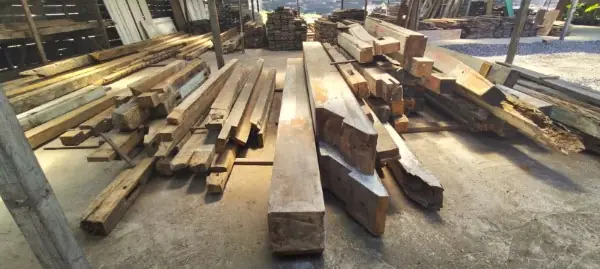
Wood is a natural material. It responds to the moisture and conditions around it, and reclaimed timber is no exception. For a project in Bali, it is useful to understand that timber can change as it moves between storage, transport, installation and its final environment.
This does not mean reclaimed timber is unpredictable or unsuitable. It means the project should be designed and installed with the properties of natural wood in mind. The exact behaviour depends on the species, section, previous use, current condition and the environment in which the timber will be installed.
Why moisture matters
Wood exchanges moisture with the surrounding air. When conditions change, the moisture content of the timber can also change. This can lead to dimensional movement, including swelling or shrinkage.
The amount of movement is not identical for every species or board. It is influenced by the wood's structure, the direction of the grain, the dimensions, the way the board was prepared and the conditions on site.
Reclaimed timber adds further variation because pieces may have different histories and storage conditions. One board may have been sheltered, while another may have experienced more direct exposure. The visible surface alone does not tell the whole story.
Bali's conditions and the project environment
Bali has periods of heavier rainfall and periods that are generally drier, but a building's microclimate also matters. Timber used outdoors is exposed to different conditions from timber installed in an air-conditioned interior. A covered veranda is different again.
The location within a building can matter too. A board close to an opening, a wet area or a strongly exposed facade may experience different conditions from timber in a protected room.
For this reason, it is not appropriate to give one moisture figure or acclimatisation period as a universal rule for every timber order. The professional responsible for the installation should assess the actual material and the site conditions.
What acclimatisation means
Acclimatisation is the process of allowing timber to adjust to the environment in which it will be used. The way it is stored during this period can influence the result. Timber should be handled and stored in a manner appropriate to the species, dimensions and intended application.
The installer should decide whether acclimatisation is required, how the material should be stacked and protected, and what checks are appropriate before installation. The correct approach can differ between interior flooring, exterior decking, cladding and furniture components.
It is better to plan these steps with the installer than to assume that every delivery should be treated in exactly the same way.
Moisture and the design of the finished surface
Natural movement should be considered in the design of timber floors, decks, ceilings and wall panelling. The project professional determines the necessary joints, clearances, fixing approach and other details based on the selected profile and site conditions.
These details should not be copied from a generic online guide. Board dimensions, installation system, exposure and substrate all influence the appropriate solution.
A well-prepared cutting list helps establish the timber dimensions and quantities, but it does not replace the installation specification. The architect or installer remains responsible for the complete design and construction details.
Reclaimed timber: character and selection
One of the attractions of reclaimed timber is that it is not visually identical from piece to piece. Marks, colour variation and differences in grain can contribute to the finished character. The same variation means that selection and preparation should be discussed in relation to the design.
If a project requires a highly uniform appearance, explain that at the beginning. If the design celebrates variation, reclaimed timber may offer the character the owner wants. In either case, the actual stock should be reviewed before final expectations are set.
Kitaru can discuss available reclaimed timber and other hardwood options. The company also offers new timber options, depending on current supply. The decision should be based on the application, desired appearance, required dimensions and the material available for the project.
Finishes and moisture protection
A finish can influence the surface appearance and how it responds to some contact with liquids. An appropriate oil or coating may help limit absorption of certain substances, but no finish makes wood completely immune to moisture, staining or damage.
The choice should be based on the species, application, exposure and expected maintenance. The installer or finishing professional should confirm the product and preparation method.
For exterior applications, the finish is only one part of the design. Drainage, ventilation, support details and exposure remain important. A coating cannot compensate for a construction detail that traps water.
What Kitaru needs for an order
For an initial conversation, send photographs, plans, project information and details about where the timber will be used. This helps Kitaru understand the project and discuss possible materials.
For a precise quotation and order preparation, Kitaru normally works from a cutting list prepared and checked by the architect or installation professional. The list should identify the dimensions, profiles and quantities required. The responsible professional determines and verifies the quantities; Kitaru prepares and supplies the wood to the stated specification.
FAQ
Does reclaimed timber move more than new timber?
There is no single answer for every board. Movement depends on species, moisture condition, dimensions, preparation and environment. The actual material and application should be assessed.
How long should timber acclimatise in Bali?
There is no universal period. The installer should decide based on the timber, its condition, the site and the intended application.
Can a coating stop timber from absorbing water?
A suitable finish may help limit absorption, but it cannot guarantee complete protection or eliminate natural movement.
Can Kitaru advise on moisture readings?
Kitaru can discuss the material and available information. The project professional should determine the checks and acceptance criteria required before installation.
Discuss your reclaimed timber project
Considering reclaimed timber for your project in Bali? Contact Kitaru to discuss the available wood options and what to consider for your intended application. You can share photos, plans or information about the site to begin the conversation. For a precise quotation and order preparation, please provide the cutting list prepared by your architect or installation professional.
Request current stock
Tell us the species, dimensions and quantity. We reply with what is available now.
Send your drawings
Architects, designers and contractors: share plans and quantities and we will come back with a tailored proposal.
Visit by appointment
We are open Monday to Friday 8:30–16:30 and Saturday 8:30–12:00 (closed Sundays). Visits to the lumberyard and showroom are by appointment only.