
Plantation-Grown Teak in Bali: Choosing New Timber for Architectural Projects
When specifying teak (Tectona grandis) for a villa, hospitality interior, or commercial building in Bali, architects and project owners often weigh two distinct supply pathways: salvaged reclaimed teak recovered from dismantled structures, and new timber harvested from managed plantations.
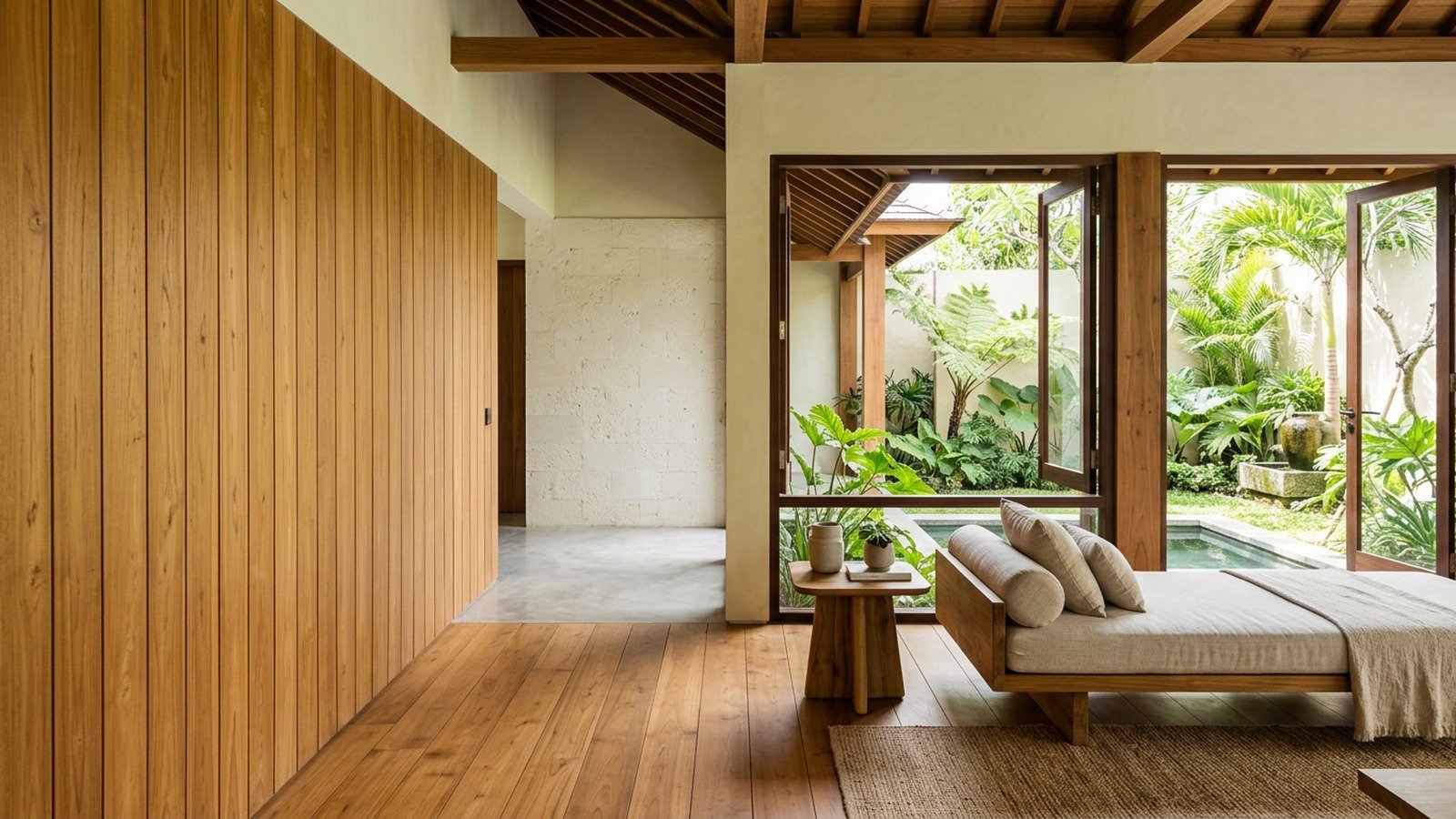
When specifying teak (Tectona grandis) for a villa, hospitality interior, or commercial building in Bali, architects and project owners often weigh two distinct supply pathways: salvaged reclaimed teak recovered from dismantled structures, and new timber harvested from managed plantations.
At Kitaru Lumberyard Bali, reclaimed hardwood is our primary focus. However, some architectural briefs call for tighter dimensional consistency across a batch, larger planned quantities, or surfaces free from historic nail marks and weathered edges. For those projects, we offer plantation-grown teak as a separate pathway—quoted, labelled, and documented independently from our reclaimed stock.
Rather than simply comparing the two types of wood in abstract terms, this guide explains how design and procurement teams specify plantation-grown teak in practice: from visual grading and Kitaru's custom processing options to lot documentation and cutting lists.
Visual Character, Variation, and Grading Expectations
Although reclaimed and plantation-grown teak belong to the same botanical species (Tectona grandis), newly harvested plantation timber presents a different set of visual and grading considerations.
Colour Variation Across Lots and Trees
Plantation-grown teak is not uniform in colour. Heartwood tones vary depending on growing conditions, tree characteristics, and log selection—ranging from pale golden-yellow and honey tones to medium or darker brown, sometimes with mineral streaks. Ordering boards from a single harvested lot generally supports better visual continuity across a room than mixing salvaged boards from unrelated buildings, but natural colour variation still remains.
Boards may also show lighter cream-to-yellow sapwood along the edges, depending on the log and how it is sawn. If your design requires predominantly heartwood faces or a narrower tone range, sapwood tolerance and sorting expectations should be clarified before milling begins.
Grain, Surface Grading, and Natural Marks
New plantation teak typically displays straight to moderately wavy grain with natural growth-ring figuring. Because the wood does not come from a dismantled structure, it will not carry old bolt holes, mortise pockets, or prior-use nail stains.
Even so, new timber is not defect-free by default. Depending on the grade agreed for the lot, boards can still show knots, pinholes, slight grain deviations, or natural checks. Acceptable surface characteristics, finish texture (such as smooth planed or brushed), and grading expectations should always be confirmed against physical samples or batch information for the proposed lot.
Heartwood Proportion and Lot-by-Lot Variability
Heartwood proportion, growth-ring spacing, and visual maturity vary from plantation to plantation and from log to log. Rather than assuming that a plantation origin or general species label guarantees a specific proportion of mature heartwood, confirm the actual timber characteristics and sample quality for the specific supply lot before locking in a specification.
Processing and Architectural Applications
Just like our reclaimed hardwood range, plantation-grown teak can be processed by Kitaru into suitable finished products and custom profiles where the material and batch are appropriate for the intended detail. Feasibility, timber selection, and pricing are confirmed per project.
Interior Flooring and Wide-Span Rooms
For living spaces, galleries, or hotel suites where designers want boards to run cleanly across connected rooms, plantation-grown teak can be planned per lot in profiles such as tongue-and-groove (T&G) or shiplap (SL). Where aged patina, old fixing marks, and stronger contrast are preferred instead, our reclaimed teak flooring remains the reference option.
Timber Ceilings, Wall Panelling, and Architectural Millwork
Slatted ceilings, wall panelling, doors, window frames, shelving, and built-in joinery often call for clean, repeatable sections without concealed metal fasteners from a previous building. Through Kitaru's processing services, confirmed plantation-grown teak lots can be re-sawn, planed, and profiled to suit project drawings.
Covered Spaces vs. Exposed Outdoor Applications
Whether plantation-grown teak is suitable for an interior, semi-covered, or exposed outdoor zone depends on the actual batch, heartwood proportion, site exposure, architectural detailing, finishing, and ongoing maintenance.
Kitaru's published teak technical data sheet, citing NF EN 350-2, lists natural-forest teak from Asia in natural durability Class 1 against fungi (Class M against termites) and teak planted in Asia and other countries in Classes 1 to 3 against fungi (Classes M to S against termites). That technical data sheet provides general reference information only—it is not a guarantee of the performance, durability, or service life of every supplied batch or project. Project-specific suitability must always be confirmed with Kitaru and your installation professional against the actual lot, exposure, detailing, and maintenance.
Standard Options, Custom Profiles, and Cutting Lists
Kitaru offers standard options alongside custom dimensions and profiles depending on the product, project requirements, and lot availability. Because plantation-grown teak is sourced and planned per project rather than held as a fixed retail shelf line, contact Kitaru to confirm current dimensions, profiles, specifications, and availability.
| Specification Element | What to Confirm Before Ordering | Why It Matters |
|---|---|---|
| Finished Dimensions | Required finished thickness, width, and length expectations | Rough sawn sections differ from finished milled dimensions after planing |
| Edge Profile | Tongue-and-groove (T&G), shiplap (SL), eased edges (E2E/E4E), or custom profile | Shapes joint appearance, coverage, and compatible fixing method |
| Grading & Sapwood | Acceptable sapwood presence, knots, and natural colour variation | Aligns visual expectations across the lot prior to milling |
| Cutting List & Schedule | Verified quantities from the project team and target build timing | Enables realistic lot availability and production checks |
| Documentation | Whether SVLK verification or FSC certification is requested for the lot | Must be confirmed against the actual batch paperwork before ordering |
Architectural drawings and elevations are helpful to open a discussion, while formal quotations and order preparation rely on a cutting list prepared and verified by your appointed architect, quantity surveyor, or contractor. There is no universal cutting-loss percentage in timber construction; actual allowances depend on room geometry, available lengths, layout pattern, and site selection. Likewise, site acclimatisation, moisture checks, subfloor readiness, and installation remain the responsibility of your contractor or specialist installer.
Batch Documentation: SVLK and FSC
When ordering plantation-grown timber in Indonesia, documentation belongs to the specific batch rather than the species name alone:
- SVLK: Indonesia's national timber legality and sustainability verification system.
- FSC (Forest Stewardship Council): A separate voluntary international certification system audited and issued by independent accredited certification bodies.
SVLK verification and FSC certification are distinct systems and are not interchangeable. Not every plantation-grown teak batch carries voluntary certification by default. As stated in our Environmental Policy, SVLK-verified or FSC-certified options may be available on request, subject to confirmation of the specific timber batch and its supporting documentation.
Frequently Asked Questions
Is plantation-grown teak kept in permanent ready stock at Kitaru?
No. Reclaimed Teak and Reclaimed Bangkirai form our core yard stock, while plantation-grown teak is offered as a separate pathway arranged per project lot. Current availability, dimensions, and timelines are confirmed upon enquiry.
Can Kitaru mill plantation-grown teak into custom profiles?
Yes. Kitaru can process plantation-grown teak into suitable custom profiles and finished products in the same way as reclaimed hardwood, subject to material suitability, lot availability, and project feasibility.
Does a datasheet durability classification guarantee outdoor performance?
No. The NF EN 350-2 classifications cited in Kitaru's teak technical data sheet are general reference figures from that source and do not guarantee the performance of every supplied batch. Project-specific suitability must be confirmed with Kitaru and your installation professional based on the actual lot, exposure, structural detailing, fixings, finishing, and maintenance.
Who prepares the cutting list and handles installation?
Your appointed architect, contractor, or specialist installer prepares and checks the cutting list and takes responsibility for site acclimatisation, finishing, and installation, in line with our Sales Agreement.
Discuss Your Plantation Teak Specification with Kitaru
If your project calls for plantation-grown teak—or if you want to compare lot options alongside our reclaimed stock—contact our team with your drawings, target finished dimensions, and project schedule.
- Enquire about current availability and dimensions: Submit your brief on our stock enquiry page.
- Send drawings directly: Message us on WhatsApp at +62 823 4248 1388 or email info@kitaru-lumberyard-bali.com.
- Visit by appointment: Our lumberyard and showroom at Jl. Pantai Saba No. 47509, Saba, Blahbatuh, Gianyar, Bali are open Monday to Friday (8:30–16:30) and Saturday (8:30–12:00), closed Sundays. Visits are arranged by appointment and depend on current stock and sample availability—please book a visit in advance.
Request current stock
Tell us the species, dimensions and quantity. We reply with what is available now.
Send your drawings
Architects, designers and contractors: share plans and quantities and we will come back with a tailored proposal.
Visit by appointment
We are open Monday to Friday 8:30–16:30 and Saturday 8:30–12:00 (closed Sundays). Visits to the lumberyard and showroom are by appointment only.