
Reclaimed Teak for Facades in Bali: Natural Character and Design Considerations
A timber facade can change the character of a building. It adds warmth, texture and a connection to natural materials, whether the architecture is contemporary, tropical or inspired by traditional Indonesian forms.
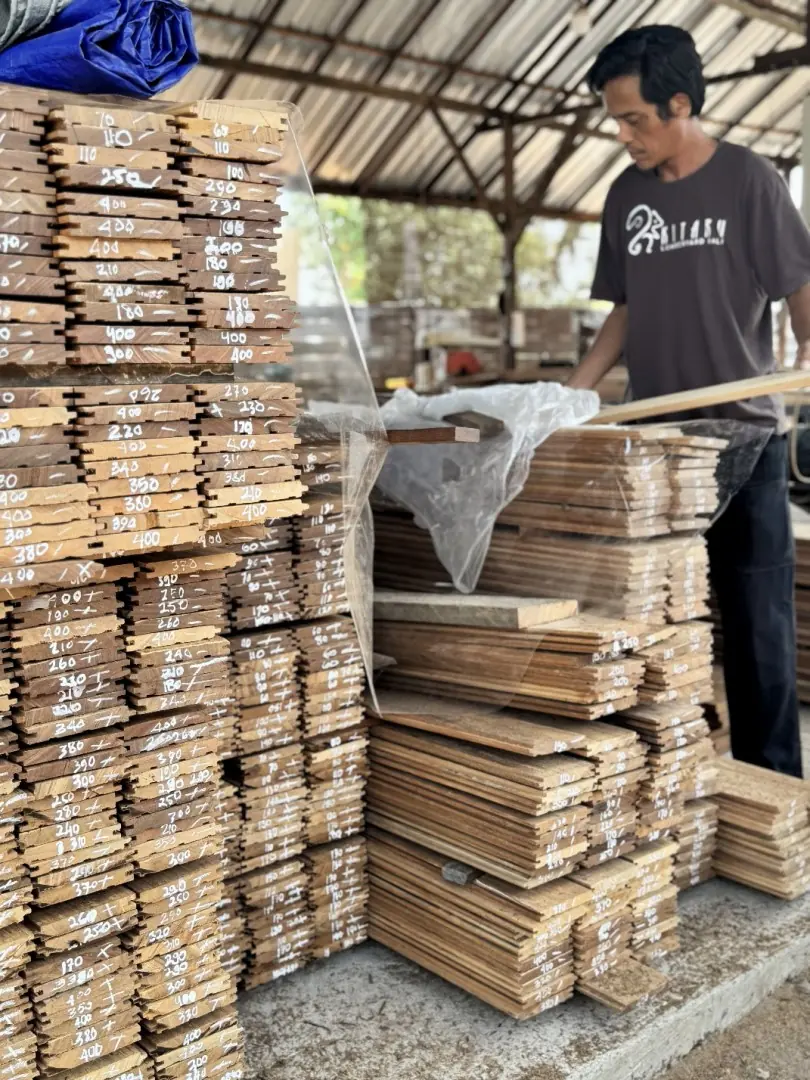
A timber facade can change the character of a building. It adds warmth, texture and a connection to natural materials, whether the architecture is contemporary, tropical or inspired by traditional Indonesian forms. Reclaimed teak is one option for projects in Bali where the appearance of the wood is as important as the overall design.
Unlike a factory-made surface with a uniform colour and grain, reclaimed teak carries visible variation. Previous use, age, exposure and preparation can leave differences from one board to another. For many designers and owners, that variation is precisely what makes the material attractive. The key is to understand what reclaimed teak can contribute and to plan the facade around the actual material.
What reclaimed teak brings to a facade
Teak is valued for its natural appearance and its use in a wide range of interior and exterior applications. Reclaimed teak adds another dimension: each piece may have its own grain, colour, marks and history. A facade made from reclaimed boards can therefore feel less repetitive than a surface built from completely uniform components.
The final appearance depends on the selected stock, the dimensions, the profile, the arrangement and the finish. Some projects favour a relatively clean and consistent look. Others deliberately show knots, old fixing marks and colour differences. Neither approach is automatically better; the important thing is to make the visual intention clear before material selection.
Reclaimed timber is not identical from one batch to another. A photograph or sample can help communicate the desired appearance, but it should not be treated as a guarantee that every delivered board will look exactly the same.
How the appearance changes outdoors
Timber exposed to sunlight, rain and changing humidity can change colour and surface texture over time. The rate and appearance of this change depend on the species, the individual boards, the orientation of the facade, the amount of direct sun and rain, and whether the surface is protected or coated.
A naturally weathered appearance may be part of the design brief. Some owners prefer timber to develop a softer, lighter tone; others want to maintain more of the original colour through a suitable finish and a planned maintenance approach. A finish can influence colour and surface behaviour, but it should not be presented as a permanent shield against weathering.
There is no single ageing timetable that can be promised for every facade in Bali. Different elevations of the same building may weather differently. A sheltered wall and a wall exposed to strong sun and rain are not equivalent conditions.
Choosing the right visual direction
Before selecting the boards, consider the overall composition. Will the facade use horizontal or vertical lines? Should the boards be narrow or wide? Is the intention to create a regular rhythm, or to highlight the natural variation of reclaimed timber?
The choice of profile also affects the result. A simple board arrangement creates a different effect from a more pronounced shadow line or a batten-based design. The architect or facade designer should define the intended dimensions, spacing and visual pattern. Kitaru can then discuss the timber options and the profiles that may be suitable.
If a project requires a highly consistent appearance, explain that early. Reclaimed timber naturally varies, and the selection process should take that into account. If the design welcomes variation, the material can become a visible part of the architectural expression rather than something to conceal.
The facade is more than its visible boards
The timber that people see is only one part of an exterior facade. The supporting structure, ventilation, drainage, fixings, junctions and protection of vulnerable details all influence how the complete system performs.
These matters depend on the building, exposure and design. They should be specified by the architect, engineer or facade installer responsible for the project. It would be misleading to suggest that choosing a particular timber species alone guarantees the performance or lifespan of the facade.
The same principle applies to concealed components. Supports and fixings should not be treated as unimportant simply because they are hidden. A well-chosen visible timber needs to be combined with a suitable supporting system and careful installation.
Reclaimed or new teak?
Kitaru's offer is not limited to reclaimed timber. Reclaimed teak may be appropriate where natural variation and character are central to the design. New teak and other hardwoods may be considered when a project needs different dimensions, a more regular appearance or another material option.
The decision should be made against the actual specification and the available stock. It is not helpful to assume that every reclaimed board will meet a particular dimension, or that a new timber option will always be available in the required quantity. Current availability should be confirmed before the design is finalised.
For some projects, a combination can be considered. The design may use reclaimed timber in prominent areas and another suitable material in secondary sections. Any combination should be intentional and clearly specified so that differences in colour, profile and finish do not become an unexpected result.
Planning a facade order
For an initial discussion, send Kitaru photographs, drawings, project references and information about the intended application. Include the preferred appearance and any dimensions already established by your design team.
For a precise quotation and order preparation, Kitaru normally works from a cutting list prepared and checked by the architect or installation professional. The cutting list should identify the required dimensions, profiles and quantities. The responsible professional determines the quantities for the facade; Kitaru prepares and supplies the timber to the specification.
This is particularly important when the facade includes openings, corners, returns, transitions or several different board lengths. The final arrangement and cutting requirements should be coordinated before the order is placed.
FAQ
Will reclaimed teak keep its original colour outdoors?
Not necessarily. Sun, rain, exposure and finishes all influence how timber changes. A particular colour or ageing schedule cannot be guaranteed.
Will every board look the same?
No. Natural variation is part of reclaimed timber. The selection and design should reflect the level of variation the project can accept.
Can reclaimed teak be used on a modern building?
Yes. Its appearance can work with contemporary architecture as well as more traditional designs. The profile and arrangement are important to the result.
Does teak alone guarantee a durable facade?
No. The complete facade system, including supports, fixings, drainage, ventilation and installation, must be designed for the project.
Discuss your facade with Kitaru
Considering reclaimed teak for your facade? Contact Kitaru to discuss the available timber, its natural character and the look you want to achieve. Send us photos or design references to start the conversation. For a precise quotation and order preparation, please provide the cutting list prepared by your architect or installer.
Request current stock
Tell us the species, dimensions and quantity. We reply with what is available now.
Send your drawings
Architects, designers and contractors: share plans and quantities and we will come back with a tailored proposal.
Visit by appointment
We are open Monday to Friday 8:30–16:30 and Saturday 8:30–12:00 (closed Sundays). Visits to the lumberyard and showroom are by appointment only.